Click any image to view full size with zoom
C. F. Wicksteed
1802 - 1846
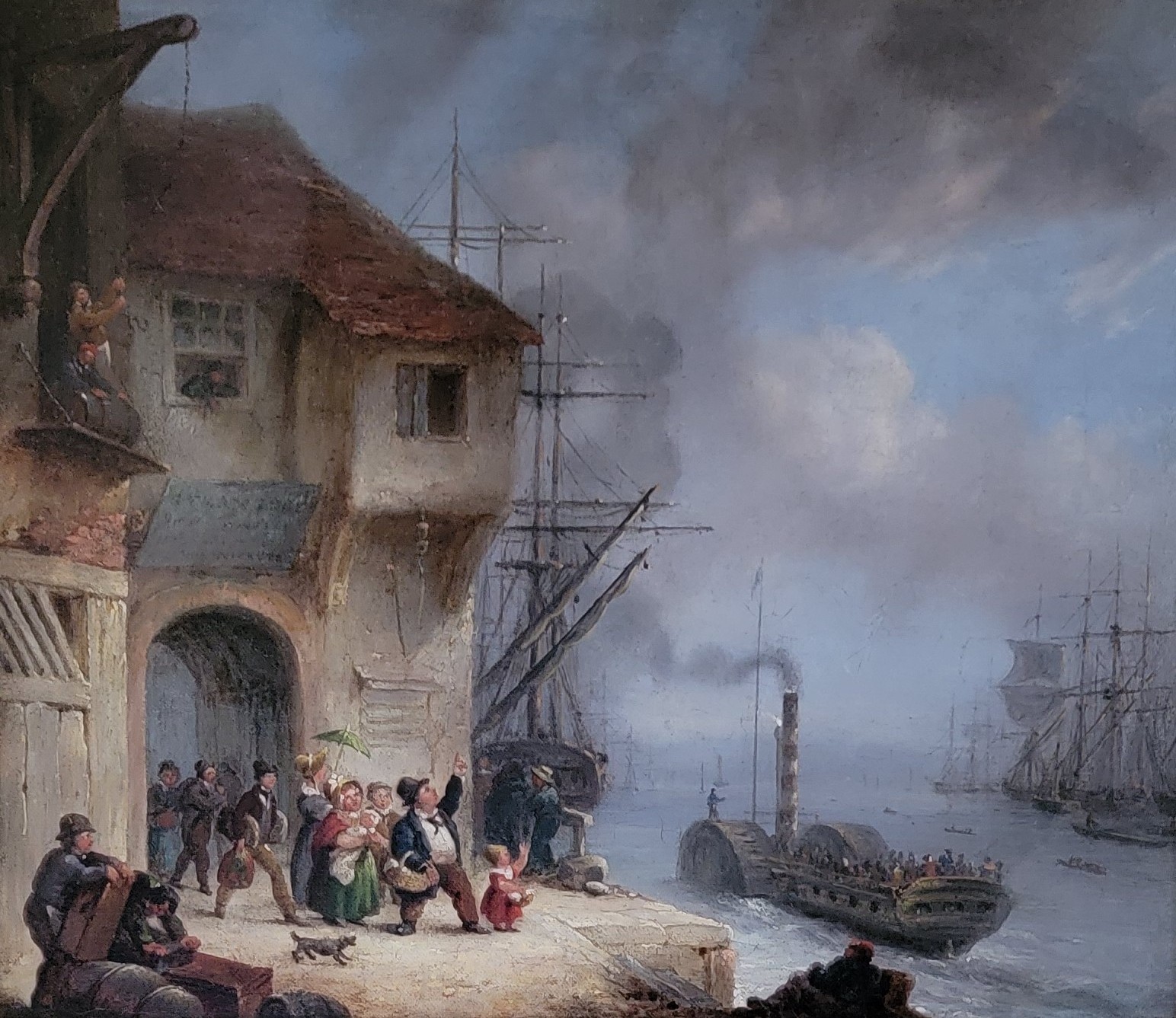
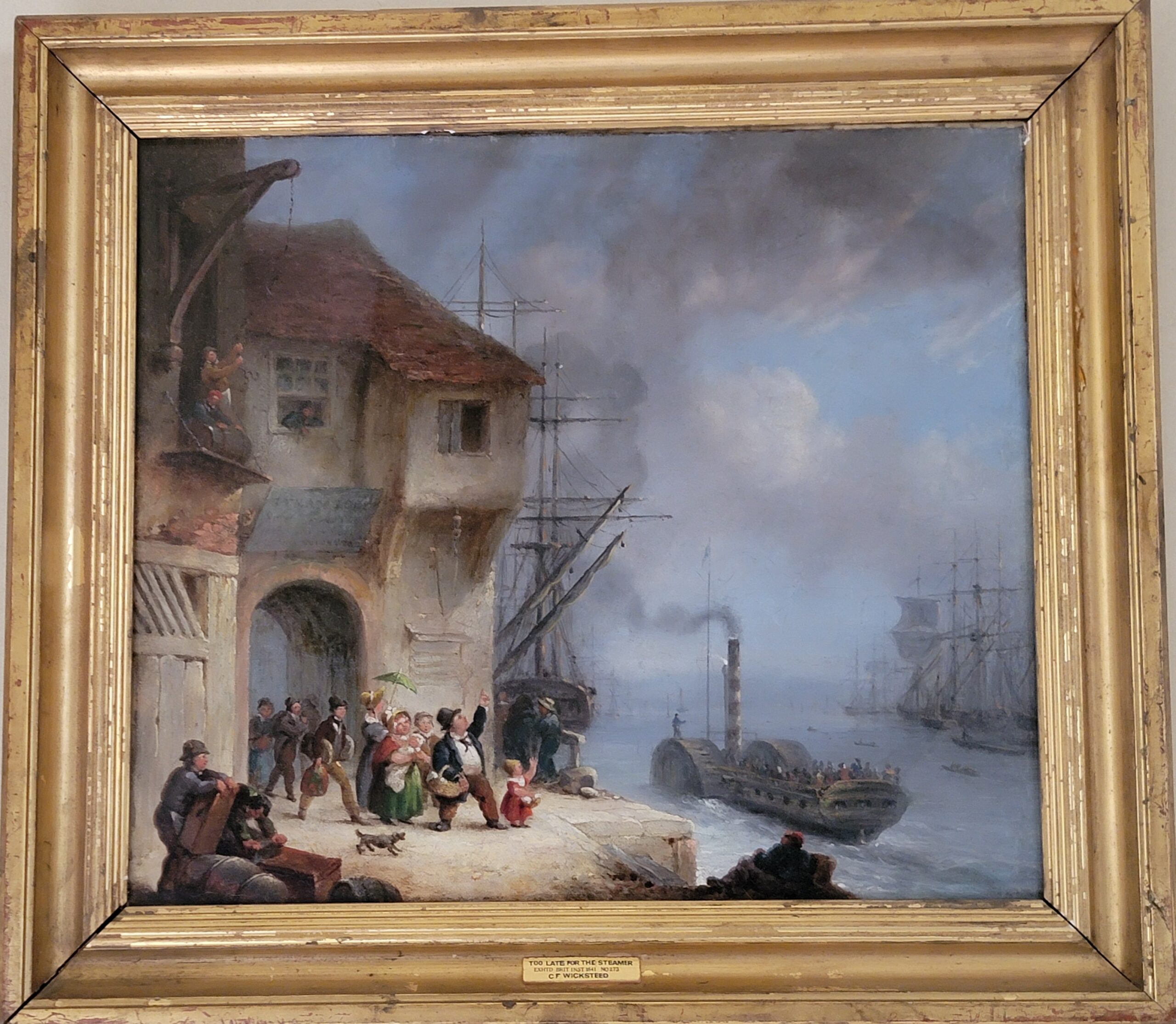
Too late for the steamer
1841
Oil on canvas
12 x 14 ins, 30.5 x 35.6 cms.
Signed and dated 1841
About the Artist
Wicksteed was a London painter who specialised in scenes from popular life, usually populated with distinctive characters. He exhibited at The Royal Academy from 1802 onwards and at the British Institution. His surviving work is today scarce. There is a good example from 1838 in the Parliamentary Art Collection, The Election: The New Member Addresses the People. There is an engraving of Stoke Park, Wiltshire after one of his paintings which suggests another aspect of his work.
Since at least 1824, when he first exhibited at the British Institution, he lived at addresses first in Soho and later in Covent Garden. In 1841 he was living at 12 Catherine Street. While his background is largely unknown, he was steeped in the creative milieu of Covent Garden and his observation (though milder) is in the tradition of Hogarth.
About this Work
Too late for the steamer is a topical incident occurring at a pier on the Thames in London. Possibly it was London Bridge Pier. The departing paddle steamer is an excursion boat. From the baskets and cushions being carried by the latecomers one can see that they were on a day’s family outing, which probably turned out to be a lot less pleasurable after missing their embarkation. One can imagine the consequent argument about whose fault it was, the children’s disappointment, mother complaining that the baby needed feeding. It is probably better not to imagine what their father is shouting after the departing boat.
Their day may not have been entirely ruined because they may well have been able to catch another steamer. By this date (1841) there were many excursion boats from London to a variety of destinations in the Thames Estuary and the Kent and Essex coasts. Steamboat services had started on the Thames in 1815 and the Steamboat Act of 1819 was the first statute to regulate their safety. By 1826 it had become clear that the steamers were established as new jetties were constructed alongside the river to service them, although it took the Watermen’s Company, which had tried to hold on to their traditional monopoly, until 1841 to establish the Watermen’s Steam Packet Company to operate their own steam service. The biggest boom came in the 1830s with the creation of the Star, Diamond and Woolwich Steam Packet Companies which added many more new boats. By 1834, when they were fighting the establishment of the Great Western Railway the Thames Commissioners boasted that they had made the Thames navigation one of the most perfect in the Kingdom.
Exhibited
British Institution, 1841 no. 273.