Click any image to view full size with zoom
Vera Willoughby
1870-1939
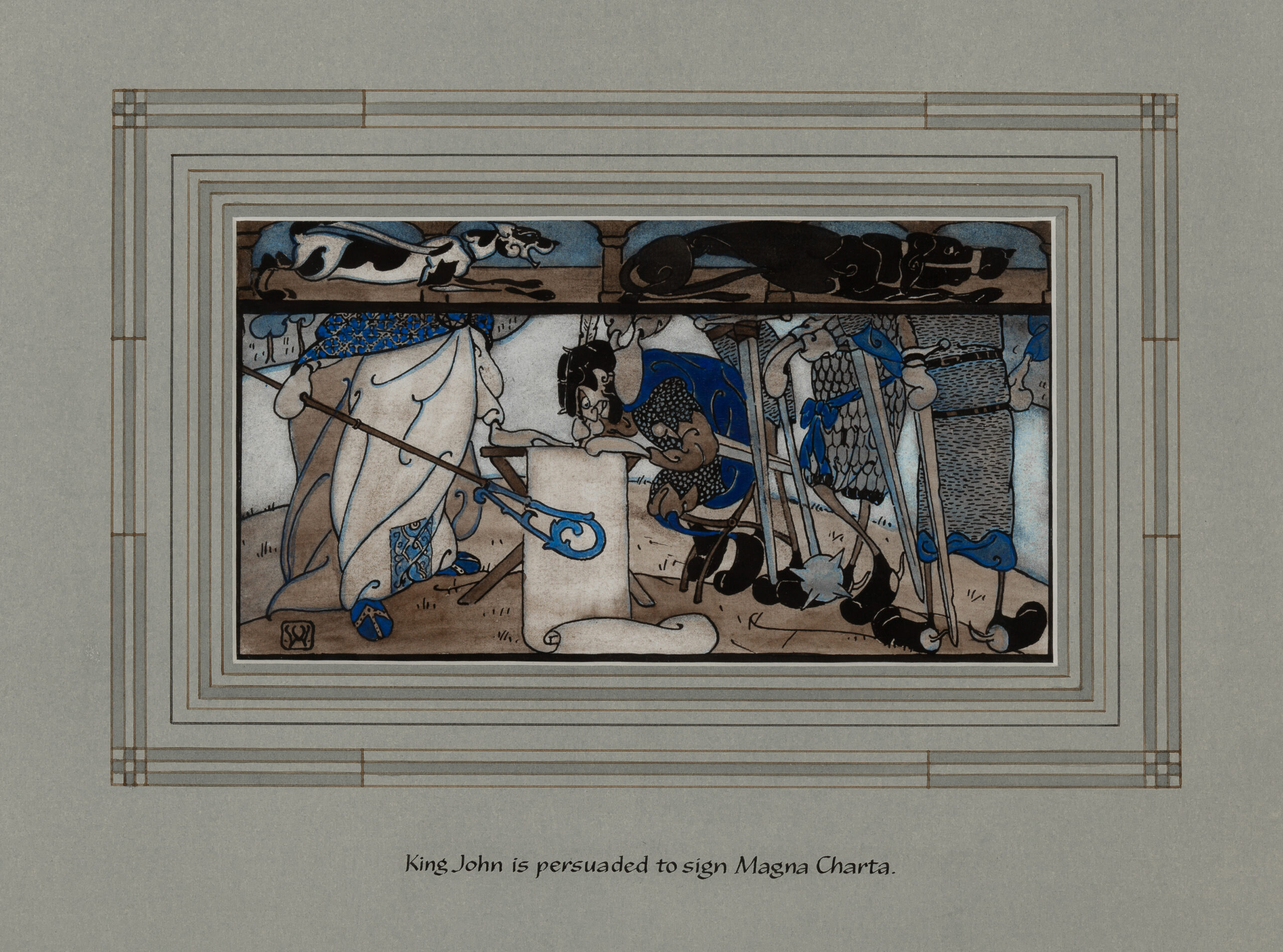
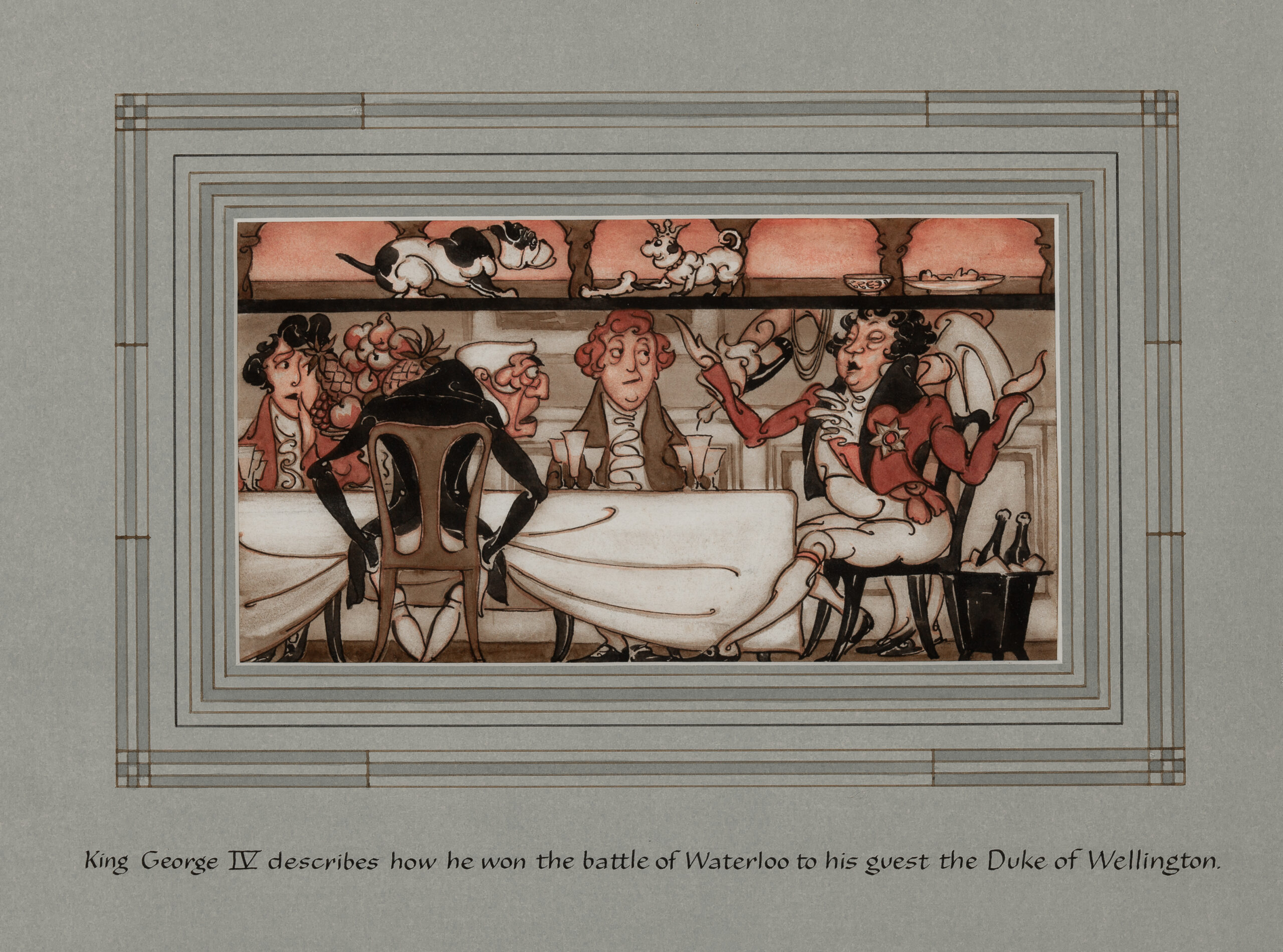
A pair of drawings: King John is persuaded to sign Magna Charta King George IV describes how he won the Battle of Waterloo to his guest the Duke of Wellington
Circa 1925
Pen and ink and watercolour
Each 5 x 9 ins, 12.7 x 22.9 cms. The framing mounts have been remade precisely from the artist’s original design.
One (King John) signed with monogram
About the Artist
Vera Willoughby was an eccentric who should have found her way into an Evelyn Waugh novel. Born in South Norwood in 1870, much of her life remains obscure although the combination of her Bohemianism with a Paris-influenced style of painting did bring her public attention. (Early accounts that she was born in Hungary were only slowly proved to have been fabricated; they were probably put about to enhance her Bohemian persona.)
She studied at the Slade School of Fine Art in the 1890s under the great teacher Alphonse Legros. Working mainly in watercolour and gouache, she illustrated a wide range of literary works and by the 1920s had developed an unusual and compelling personal style. From 1928 she designed influential posters for the London Underground. Her oil paintings were exhibited at The International Society of Painters, Sculptors and Gravers, which was the opposite pole of taste to The Royal Academy. Under the name Vera Petrovna she also created designs and illustrations of ballet dancers.
Vera married the English silent film actor and director Louis Willoughby (1876-1968). Their daughter Althea Willoughby (1904-1982) studied at the Royal College of Art in the 1920s and became an illustrator, wood engraver and designer.
In 1917, while still married, Vera met Peter Llewelyn Davies (1897-1960). He had been identified by J. M. Barrie as the source for the name of the title character in Peter Pan and in 1910 Barrie had become his guardian. In 1917 Davies was 20 years old and three years into his service in the British Army. Despite the age difference Davies courted Vera and stayed with her when on leave. This scandalized J. M. Barrie and caused a rift between the two men. The relationship continued past the end of Davies’ military service in 1919. In 1926, Peter Davies’ newly-established publishing house produced an edition of George Farquhar’s 1706 comedic play The Recruiting Officer featuring illustrations by Vera.
About this Work
Vera’s work is today is hard to find. The present pair of humorous drawings, probably executed circa 1925, have been in a private collection for many years. It is possible that they were made as parodies of well-known paintings.
Benjamin Haydon had in 1840 painted The Duke of Wellington describing the field of Waterloo to George IV.
There are many recreations of King John assenting to Magna Charta. Between 1925 and 1927, however, the subject was painted by Charles Sims as his contribution to a series to decorate St. Stephen’s Hall, Westminster. Out of keeping with the style of the other paintings, Sims’ work caused great controversy at the time and would have been topical within Vera’s circle.