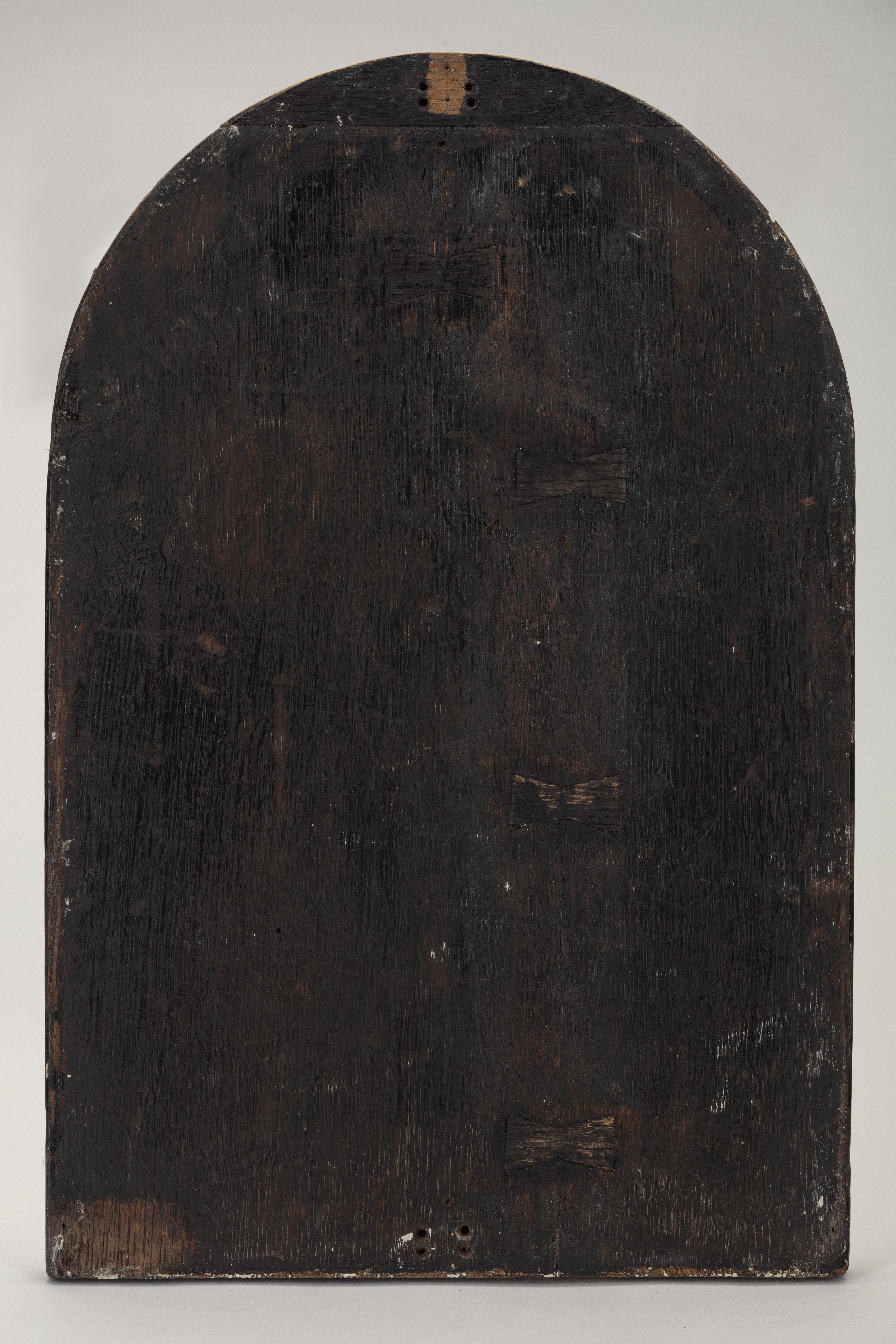
Reverse of panel
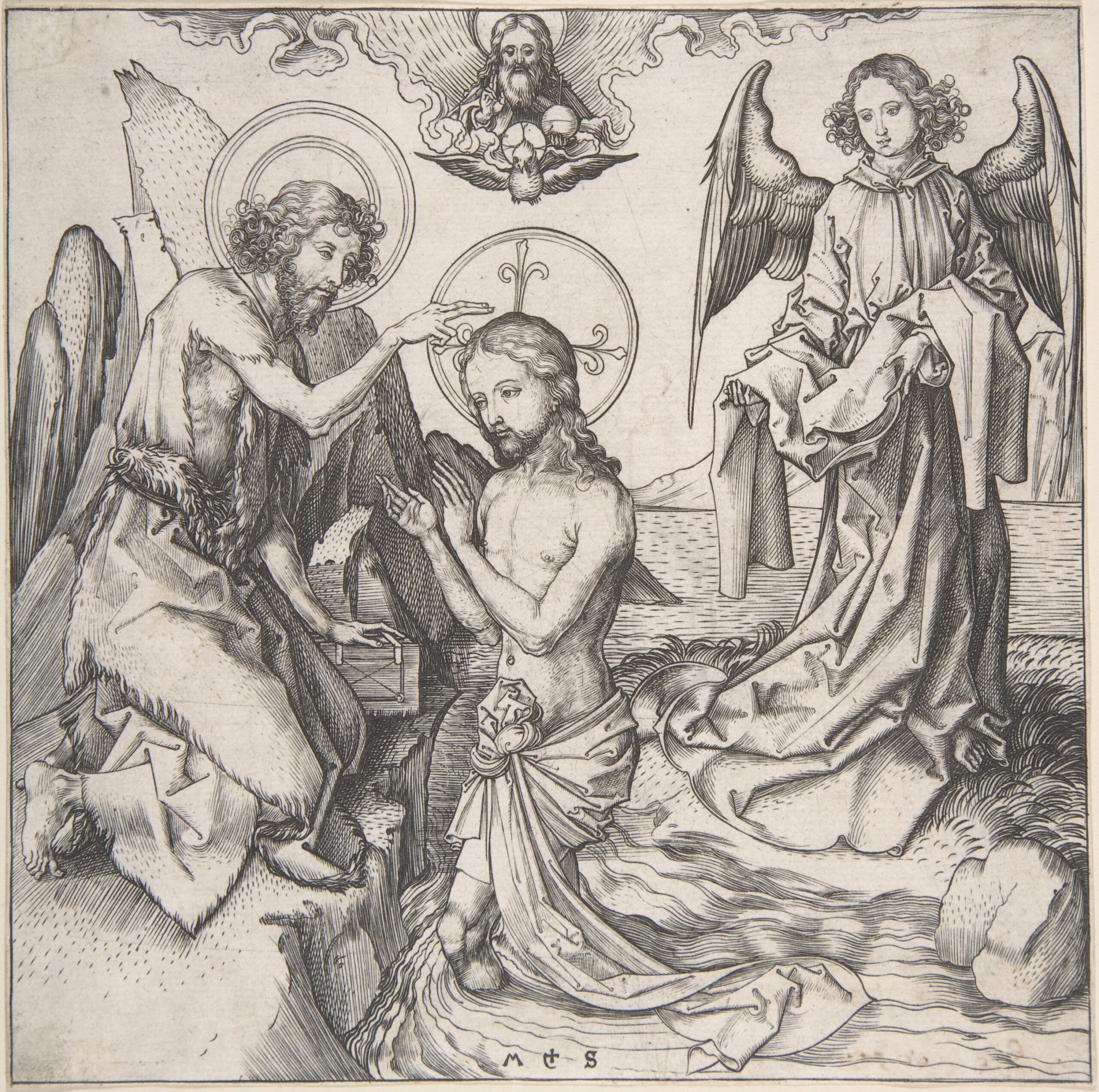
Schongauer engraving
Click any image to view full size with zoom
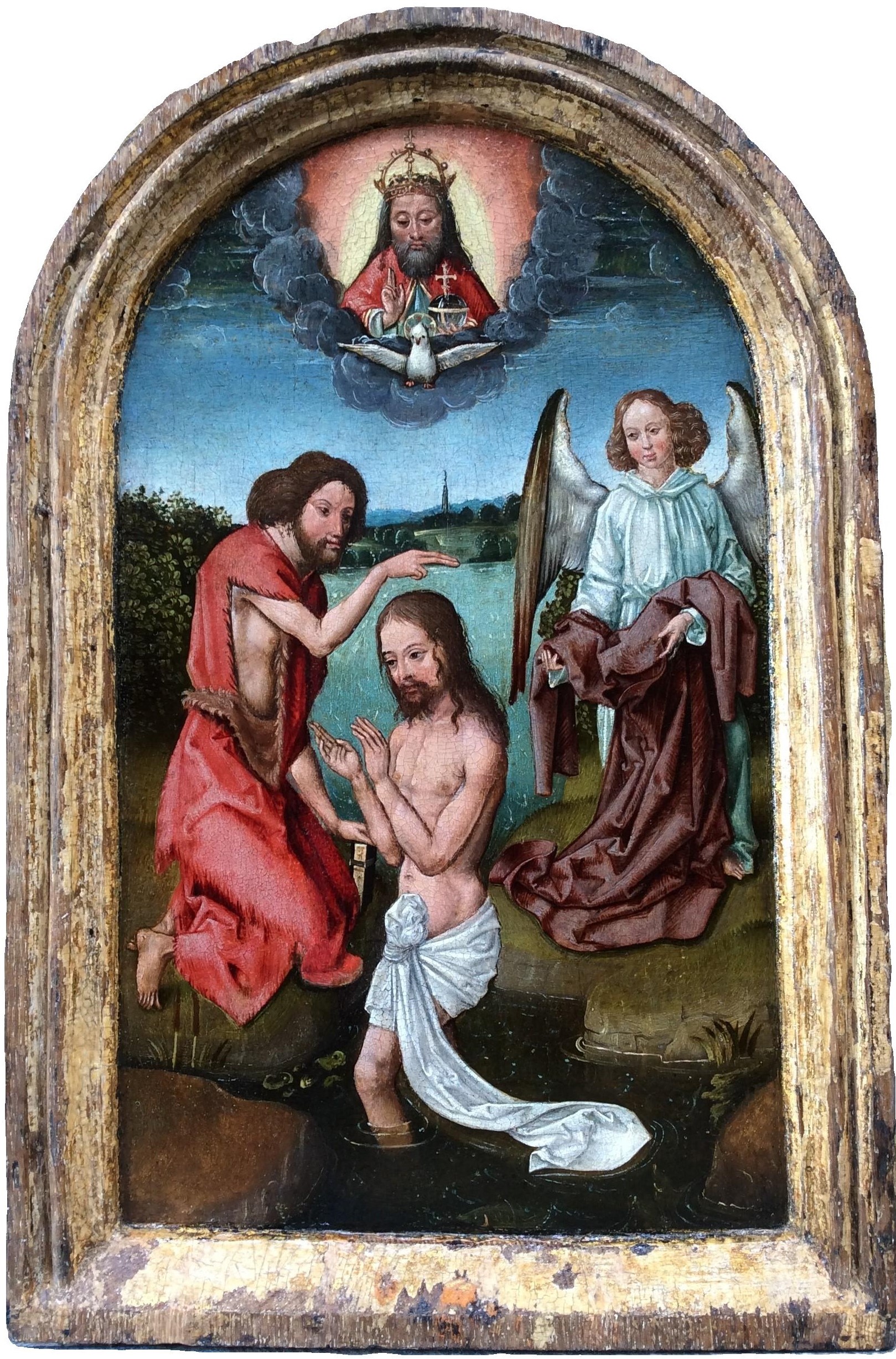
Circle of Martin Schongauer
Circa 1490
The Baptism of Christ
Oil and gold ground on a fine quality Baltic oak panel
33 x 19.7 cms. (image size) and 39.2 x 25.8 cms. (overall with the frame)
Unsigned. There is a possible monogram on the edge of St. John's book.
About the Artist
Date and authorship
Tree-ring analysis indicates that the panel with its integral frame was probably constructed between 1465 and 1499.
Integral frames tend to be found on smaller panels such as this. In the National Gallery, London, there are examples on a panel from the workshop of Robert Campin, 22.5 x 15.4 cms. (NG 6514) and on a portrait on panel by a follower of Robert Campin, 22.7 x 15.2 cms. (NG 6377). There is also a wing from a Cologne school triptych (NG 6497).
Research of the present painting suggests the hand of a painter close to Martin Schongauer. There are paintings by Martin Schongauer which incorporate a gold background and he also painted panels of varied sizes and on supports made from different woods. There are a number of characteristics of the present painting which are very close to details in Martin Schongauer’s engraved works. Examples include elongated fingers, the depiction of lips, the treatment of cascading hair and the shapes of drapery. In the Nativity engraving there are heavy lines across the palm of the Virgin’s hand which are similar to those on Christ’s left hand in the Baptism.
About this Work
Description; result of tree-ring analysis
The painting is on a fine quality oak panel measuring 33 x 19.7 cms. (image size) and 39.2 x 25.8 cms. (overall with the frame).
The panel is in an integral frame. Examination of the reverse shows that a narrow strip has been let into the very top of the frame to strengthen it. Its depth is approximately one-third of the frame’s thickness. The frame’s surface had been restored, probably in the second half of the C20th, by the application of a layer of gesso overpainted with gold colour and black sides. This has now been removed, revealing the original ground layer with traces of gilding.
A tree-ring analysis has been made by Ian Tyers of Dendrochronological Consultancy Limited and the result indicated that the board was from the eastern Baltic and that the panel was probably constructed between circa 1465 and circa 1499.
There is a vertical crack running from the base of the panel through the figure of St. John. This was repaired in the earlier C20th and the paint surface was restored and retouched. This is probably when some of the sky was restored in a new blue which subsequently darkened. Its removal revealed part of a gold ground.
Origin of image and process of composition
The earliest known version of this composition of The Baptism of Christ is a drawing in the Louvre, Paris, circa 1445-50 by the Master E.S. He was an artist from the Rhineland considered to be the most important engraver before Martin Schongauer (circa 1435/50-1491). It has been suggested that the Master E.S. may have copied this drawing from the work of another artist, perhaps a lost wing of a retable by the 1445 Master from the Upper Rhine region. It has also been suggested that the prototype might have been Franco-Flemish, as has been suggested in the case of Rogier van der Weyden’s mid-C15th Baptism of Christ from the St. John the Baptist triptych in Berlin.
Extremely close to the present painting is an engraving by Martin Schongauer circa 1470-74. In the painting there are several small differences from the engraving, mainly because the engraving is 15.9 cm square and the composition of the painting is oblong with an arched top to accommodate God the Father. To adapt to this shape the figures have been moved closer together, St. John’s right hand is higher and his left hand on an upright book, the angel closer.
The main difference, however, is the background. In the engraving there are rocks on the left, with the River Jordan (at a level below Christ’s shoulder) extending across to the right where there is a rocky shore rising up behind the angel. The figure of God the Father is very similar although He is not wearing a crown. In the painting, there are bushes behind St. John and the angel. The river level is higher and on the far shore there is a more Netherlandish-style landscape background with trees and a spire.
The conservation questions were therefore whether the background to the painting was part of the original composition and what was the function of the gold ground.
There is an interesting related Bohemian painting of the Baptism which also derived from the Schongauer engraving. It is also the closest painting to the present Baptism which has been found. This is the side wing of the large Gothic altarpiece of Saint John the Baptist (1490-1514) from Kisszeben (now Sabinov, Slovakia) on display in the Hungarian National Gallery in Budapest. Here, while there are still rocks on the left, there is a strip of landscape with trees running from St. John across to the right, incorporating a dove over Christ’s head. Above the landscape there is only gold ground. The heads of Christ and St. John are surrounded by incised gold haloes. (One of the questions about the present painting is the apparent absence of haloes, or any kind of glory, even around the head of Christ.) The gold ground is abraded. It is not known to what extent it may have been restored or whether it was ever overpainted.
The Bohemian painting while very close to the Schongauer engraving is not a copy of it. The angel, for instance, has been turned to narrow the picture. But the Bohemian painting does suggest that the present Baptism might originally have been painted with some visible gold ground at the top. The current conservation work has shown that, while the sky had comparatively recently been partly restored with a blue which had darkened, there is an old blue sky which is mostly still in place. It appears that the restoration had been necessary after overcleaning had revealed a band of the gold ground or it may have been that the restorer revealed it deliberately but was unable to understand the original composition. The gold layer does not cover the whole panel. There is no evidence of gold lower than the sky level and it may not extend to the very top where God the Father appears. The gold which was revealed is very old and the restorer had needed heavy paint to conceal it.
Inspection during the latest conservation showed that the gold ground starts at or near the top of the panel and extends down to the lower edge of the sky. The angel was painted on top of the gold ground. At the top of St. John’s head not only was restoration blue removed from over his hair but old blue sky as well, his hair being painted directly onto the gold.
This means that the figures of St. John, Christ and the angel were all painted before the present sky, river and landscape background were added. It is the conservator’s opinion that the present background is almost the same age as the original paint elsewhere so was painted at about the same time. There is no indication that it was repainted over an earlier background. The IRR report suggests that the composition was developed as the painting progressed rather than being fixed from the outset. There is repeated free interpretation at the painting stage.
The same is true of the figure of God the Father at the top of the panel. It is part of the original painting with changes made from the underdrawing and then the addition of a crown. It is almost the same as the figure of God in the Schongauer engraving. The only significant difference is the crown (which is the same style as worn by God in the Sovereign’s Prayer illumination circa 1420 from the Turin Hours by Jan van Eyck). The underdrawing suggests that the clouds which extend upwards on either side were elaborated from the more ribbon-like surround copied from the engraving.
This reflects a complex cultural change reaching the Upper Rhine. In the C15th there was a major shift in the taste of patrons of Netherlandish painters. Following the mainstream of late medieval religious practice, paintings of religious subjects now had to be depicted in contemporary settings whether indoors or outside. Most early Netherlandish panels took realism further and populated their settings with almost entirely humanised saints, often not marked out with haloes of any kind. The old representations with their echoes of the tradition of icons were no longer in demand. Therefore the gold ground panels and the various employments of gold leaf to accentuate holiness or value were supplanted by this new realism. This was not confined to new commissions. There is a Crucifixion circa 1440 in Berlin, by a painter of the Flémalle group or from the circle of Rogier van der Weyden, where the gold background was in the C16th entirely painted over with extended landscape and sky.
This development can be seen in the background to another painting derived from the Schongauer engraving but updated to take account of current taste. This is the Baptism triptych circa 1500-20 by the Master of Frankfurt.
In the Upper Rhine the move towards realism was slower to be adopted by painters and the present panel belongs to this evolutionary period. The IRR report mentions that it is not uncommon in such paintings, for a variety of reasons, to find gilding extending beyond the areas of painted design. It was also more common in Germany than in the Netherlands to find gilding used on smaller panels. Even when it was painted over it was still being used to achieve enhanced effects.
Further Information
Please contact us for copies of technical reports. Larger images and IRR images are also available.
Provenance
The framed panel was mounted on a maroon velvet backboard and enclosed in a glass-fronted box. On the back of this box is a stencil 375 ZJ which relates to lot 40 in a sale at Christie’s, London, on 31 October 1975.
“Bouts
The Baptism of Christ
On panel-arched top 13 x 7 ¾ ins (33 x 19.7 cm)
The property of a Gentleman”
The consignor was L. H. Gilbert, Avenida Almirant Gago Coutinho 33, Lisbon 5, Portugal.
Sold for £892.50 (850 guineas) to Norton.
No earlier provenance has yet been found.