Click image to view full size with zoom
Sir Henry Raeburn
1756 (Stockbridge, Edinburgh) – 1823 (Stockbridge)
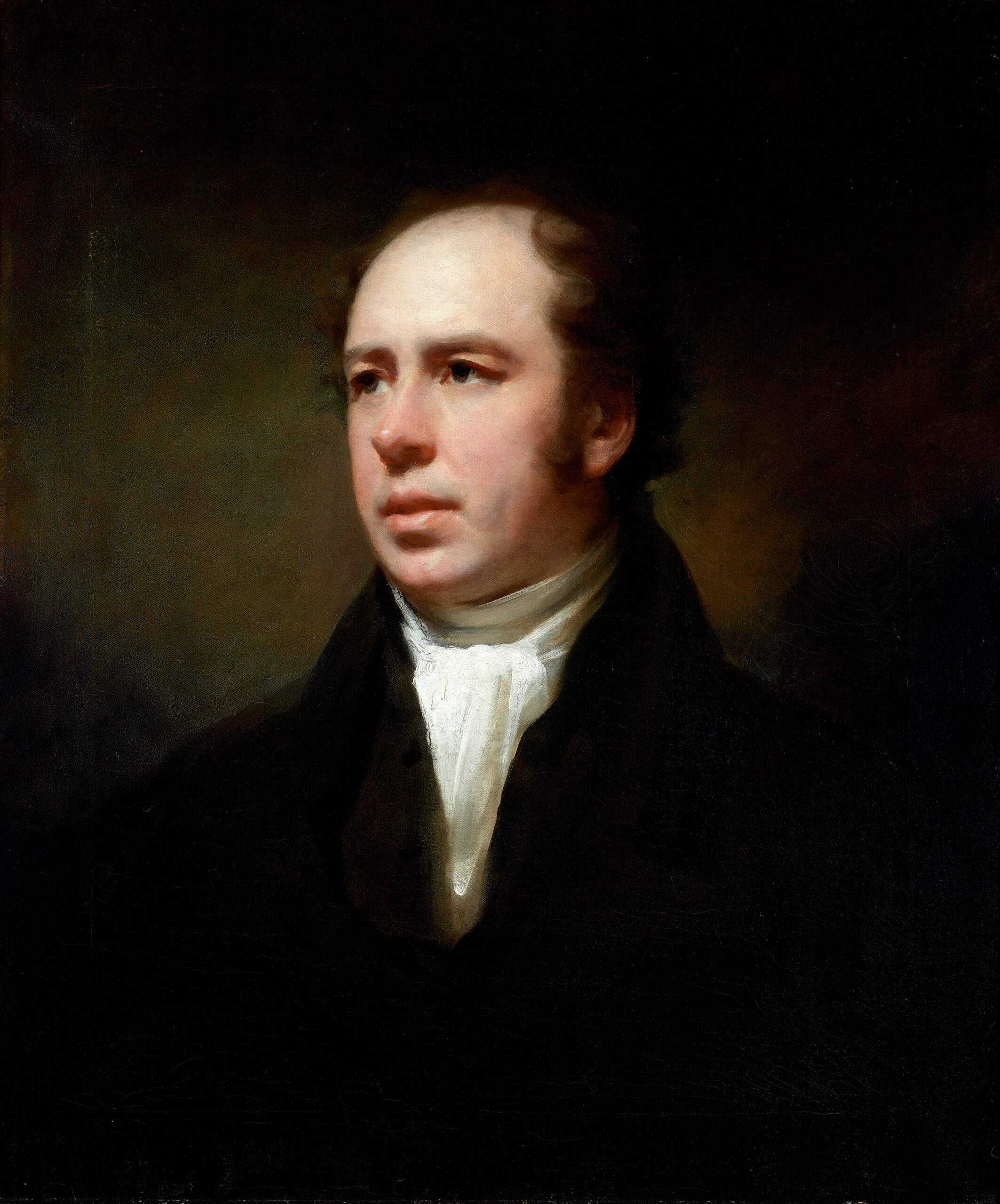
The Reverend John Thomson of Duddingston (1778-1840)
1818-1820.
Oil on canvas, in its original frame
29.75 x 25 ins., 75.5 x 63.5 cms.
Unsigned
About the Sitter
John Thomson of Duddingston was born at Dailly in South Ayrshire where he succeeded his father as minister in 1800. In 1805 he moved to be minister of Duddingston Kirk, near Edinburgh. Besides being a minister, however, Thomson had a parallel career as a highly accomplished and famed painter of landscape. He enjoyed enormous public success and his paintings commanded large sums. He was also much respected by critics and by fellow artists.
He had shown his aptitude for painting while young. Nevertheless, in 1791 he began studying law and theology at Glasgow University and in 1798 transferred to Edinburgh University to continue studying for the ministry. It was there that he met people who were prominent in artistic circles, including Alexander Nasmyth from whom he took art lessons for about a month. On his return to Edinburgh as minister of Duddingston, he was able to renew his artistic acquaintances, including Sir Walter Scott and Raeburn. He also became a friend of J.M.W.Turner, with whom he collaborated in producing engravings to illustrate Scott’s 1826 publication Provincial Antiquities and Picturesque Scenery of Scotland.
Thomson was elected an Honorary Member of the Royal Institution for the Encouragement of the Fine Arts in Scotland and of the Royal Scottish Academy. The greatest Scottish painter of his generation, he was an influential figure in the development of the Scottish school of landscape painting.
About this Work
Here is an outstanding example of Raeburn’s skill in perceptive, sympathetic portraiture. Depictions by one artist of another always have a special appeal. Raeburn himself clearly loved this painting of his friend which he kept for himself. It then stayed in his family for many years. It is a lively and characterful image with a strong presence
Willian Baird, in the appendix to his book John Thomson of Duddingston, Pastor and Painter, gave the date of this painting as 1823. It has recently been seen by Professor David Mackie who thought a more likely date was 1818-1820.
Further Information
Reproduced:
- Engraved by A. Hay in 1822 or later.
Condition
Very good. The canvas is believed to be unlined
Provenance
- Sir Henry Raeburn and by family descent after his death
- Christie, Manson & Woods, 1877- 75 gns. To Sir William Stirling-Maxwell of Keir
- By descent to his son, Archibald Stirling of Keir
- Christies, King Street, 16 November 1990
- Private collection, Scotland
Exhibited
- 1824, Raeburn exhibition in the Artists’ Gallery, York Place, Edinburgh, the exhibition held after Raeburn’s death.
- 1876, Raeburn Exhibition, The National Galleries, Edinburgh.
Literature
- Sir Walter Armstrong, Sir Henry Raeburn, 1901, listed on p.113, with owner given as Mr. Archibald Stirling (checklist prepared by Sir James L. Caw).
- Willian Baird, John Thomson of Duddingston, Pastor and Painter. Appendix lists portraits and gives date of Raeburn’s painting as 1823.
- James Greig, Sir Henry Raeburn, published by The Connoisseur, 1911. This includes a list of paintings where this portrait appears on page 61.
- David Mackie catalogue no. 708.
- Anonymous m/s of mezzotints after Raeburn, no. 50.