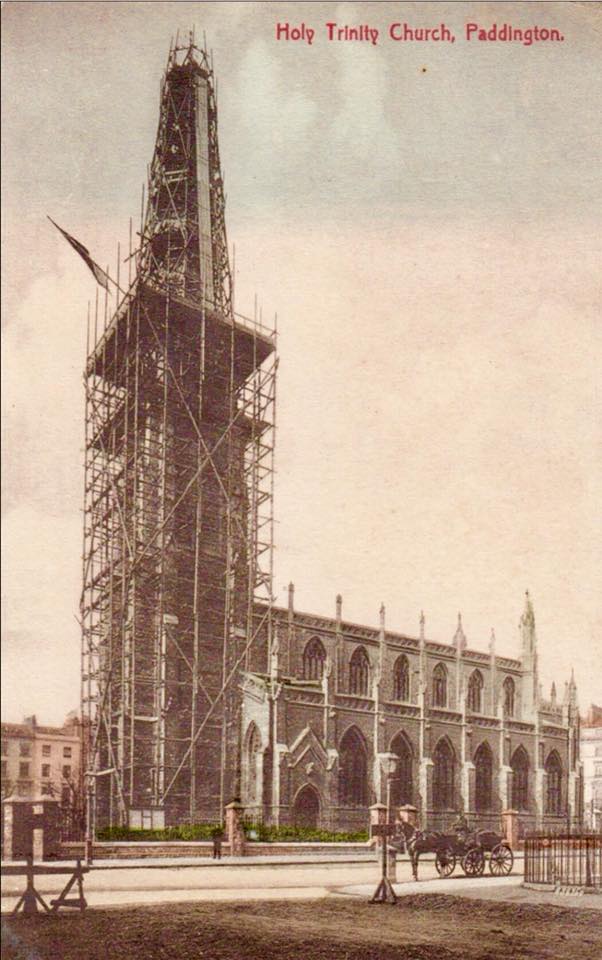
1911 photograph
Click any image to view full size with zoom
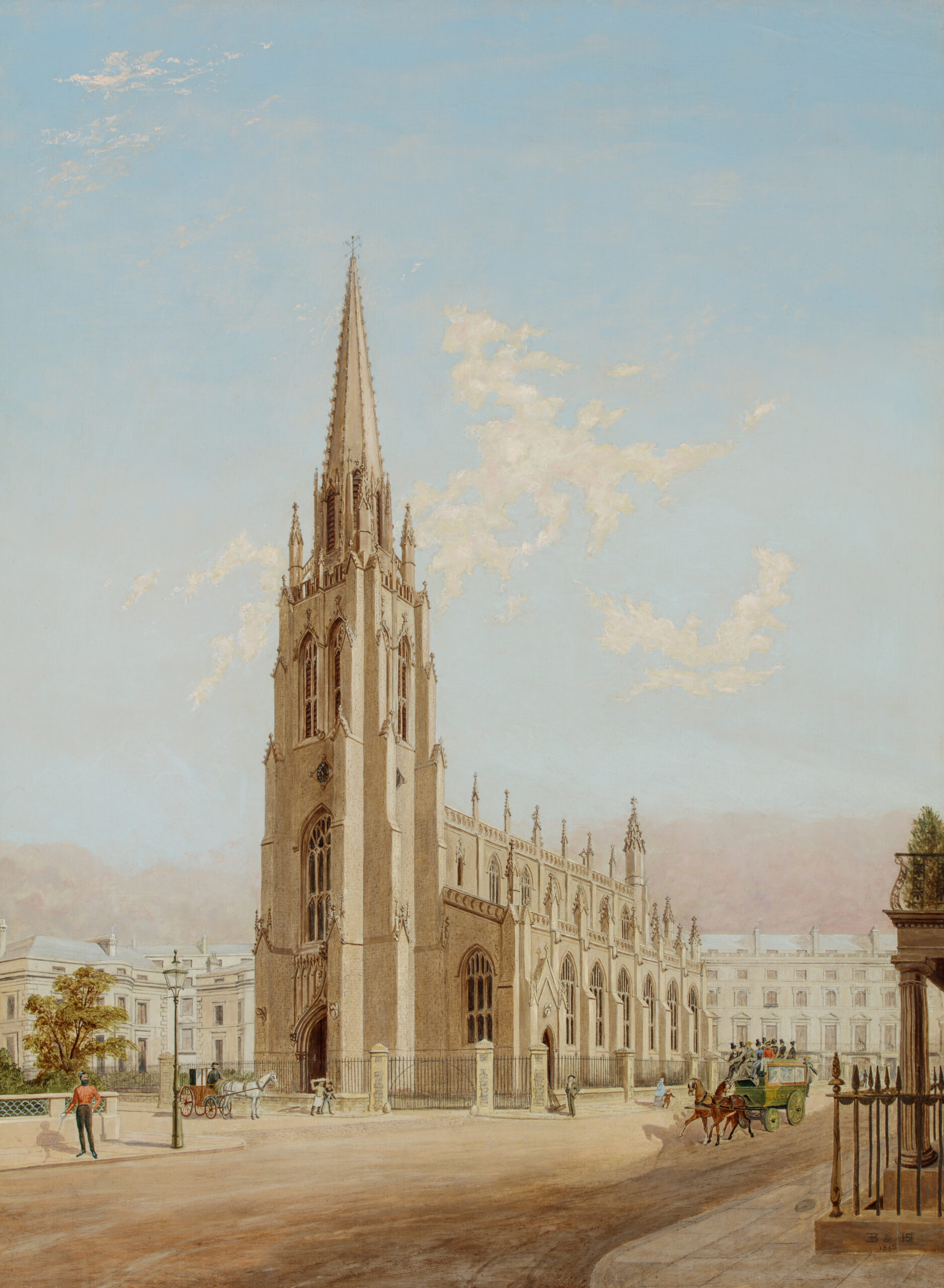
Thomas Hosmer Shepherd with figures by the artist E.B.
1793 (France)-1864 (Islington)
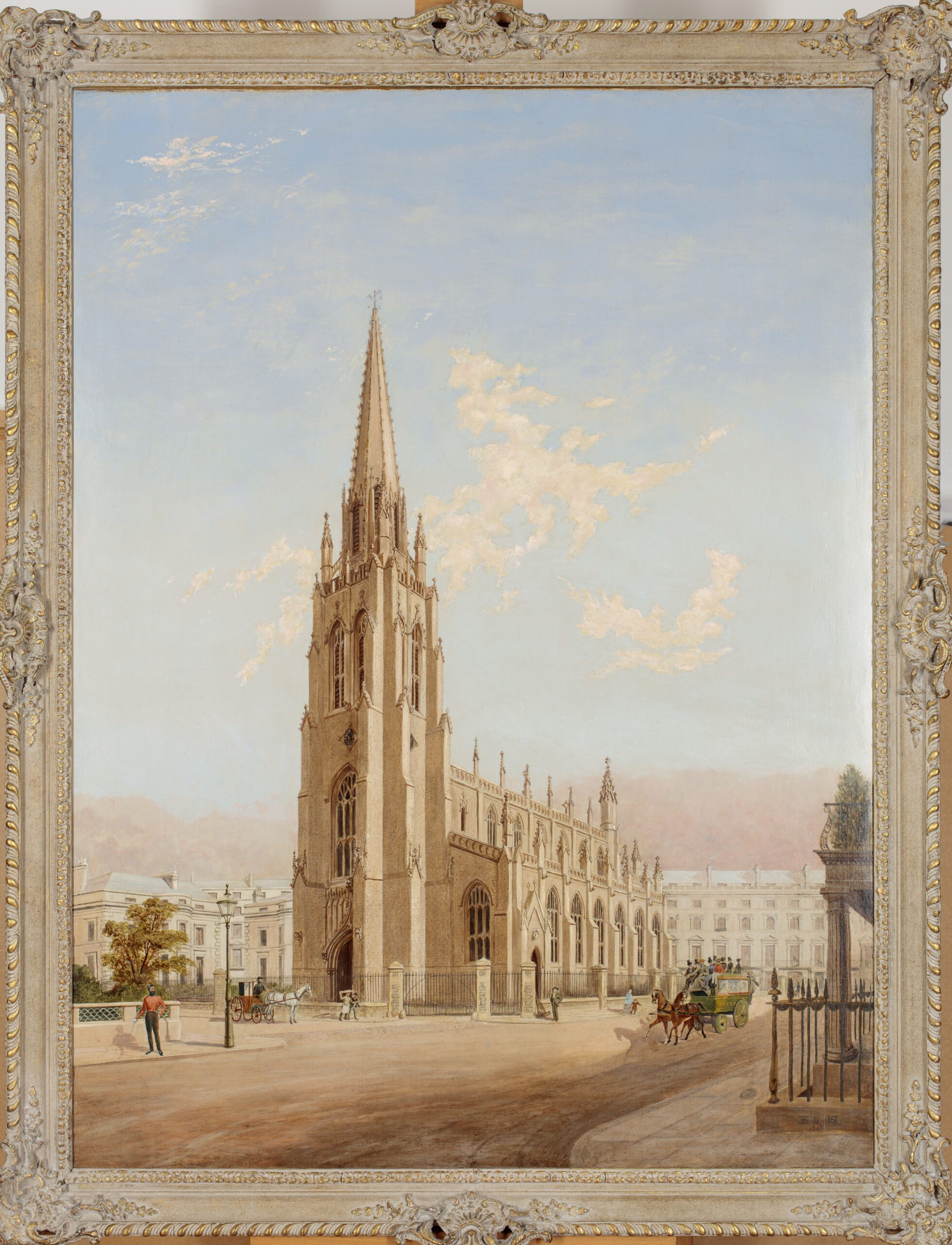
One of London’s lost 19th century churches: Holy Trinity Church, Gloucester Gardens, Bishop's Road, Paddington
1858
Oil on canvas
48 x 36 ins, 122 x 91.5 cms.
Signed lower right H.S. and E.B. and dated 1858
About the Artist
Thomas Hosmer Shepherd is best known for his watercolour drawings of street views, especially in London, many of which were published as book illustrations or as individual prints. The interior designer Frederick Crace was his lifelong patron.
This oil painting was clearly an important commission. The church and surrounding buildings are painted by Shepherd while the figures are the work of E. B. (as yet unidentified).
About this Work
The painting records a detail in the development of the land to the south of the old hamlet of Westbourne. Building around Westbourne Green had begun by the 17th century. It was still considered a beautiful, rural, place in 1820. The Grand Junction Canal was considered a scenic enhancement and was later used to attract expensive houses to the area.
In the mid-19th century this southern area was being intensively developed with a plan including spacious terraces and squares for the affluent middle classes. This urbanisation of old villages and hamlets was also influenced by the introduction of new transport hubs close by. Paddington basin, the terminus of the Paddington arm of the Grand Junction Canal, had opened in 1801. The cutting of the Great Western Railway across the middle of Paddington Green began in 1836. In 1838 a temporary station was opened on the Bishop’s Bridge Road for the new railway line which had been constructed as far as Maidenhead. 1841 saw the opening of the complete line to Bristol and a consequential growth in traffic. In 1850 the Great Western Railway Company commissioned Brunel to build the permanent Paddington Station beside Eastbourne Terrace and this was opened in 1854.
The residential developments created a need for new churches. Holy Trinity Church was built between 1844 and 1846 to the designs of Thomas Cundy junior (1790-1867). Cundy joined his father’s architectural practice and ultimately succeeded his father as surveyor of the Grosvenor estate. He held this position during the main phase of the development of Belgravia and Pimlico by the contractor Thomas Cubitt.
By 1858, when this picture was painted, the character of the area had changed very fast and the new, wealthy residents had attracted the development of new shops (to replace the villas) in Westbourne Grove which were described in the Paddington News in 1859 as “unsurpassed by any in London”.
Holy Trinity closed in 1971. The magnificent spire (with which there seem to have been structural problems since the early 20th century) was demolished in 1972 and the rest in 1984.
There is a photograph of the church taken in 1911 showing the spire surrounded by scaffolding. This is probably evidence of long-term problems with the stability of the spire.