Click any image to view full size with zoom
Glyn Warren Philpot RA
1884 (London) – 1937 (London)
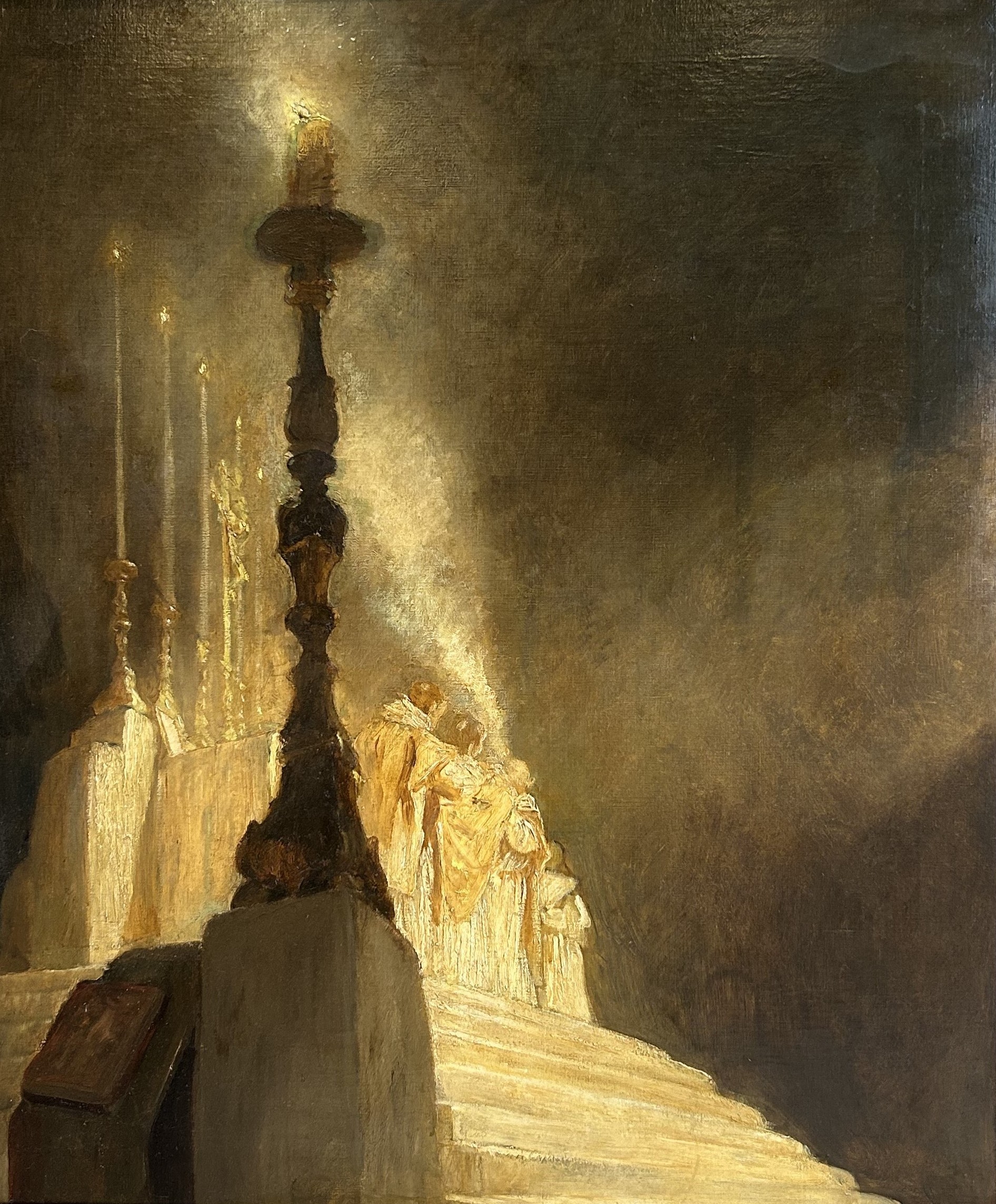
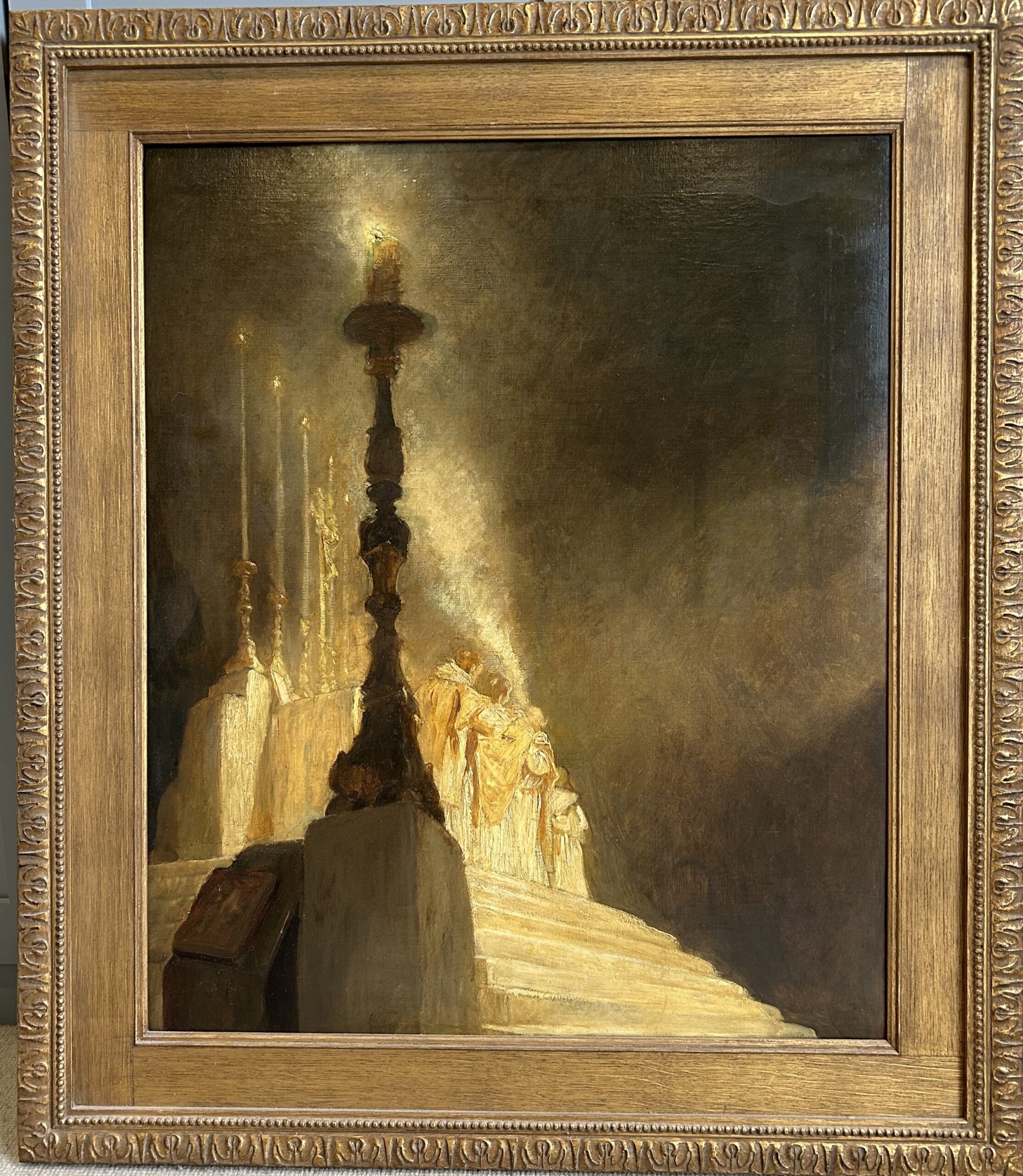
The Paschal Light
1912
Oil on canvas
30 x 25 ins., 76.2 x 63.5 cms.
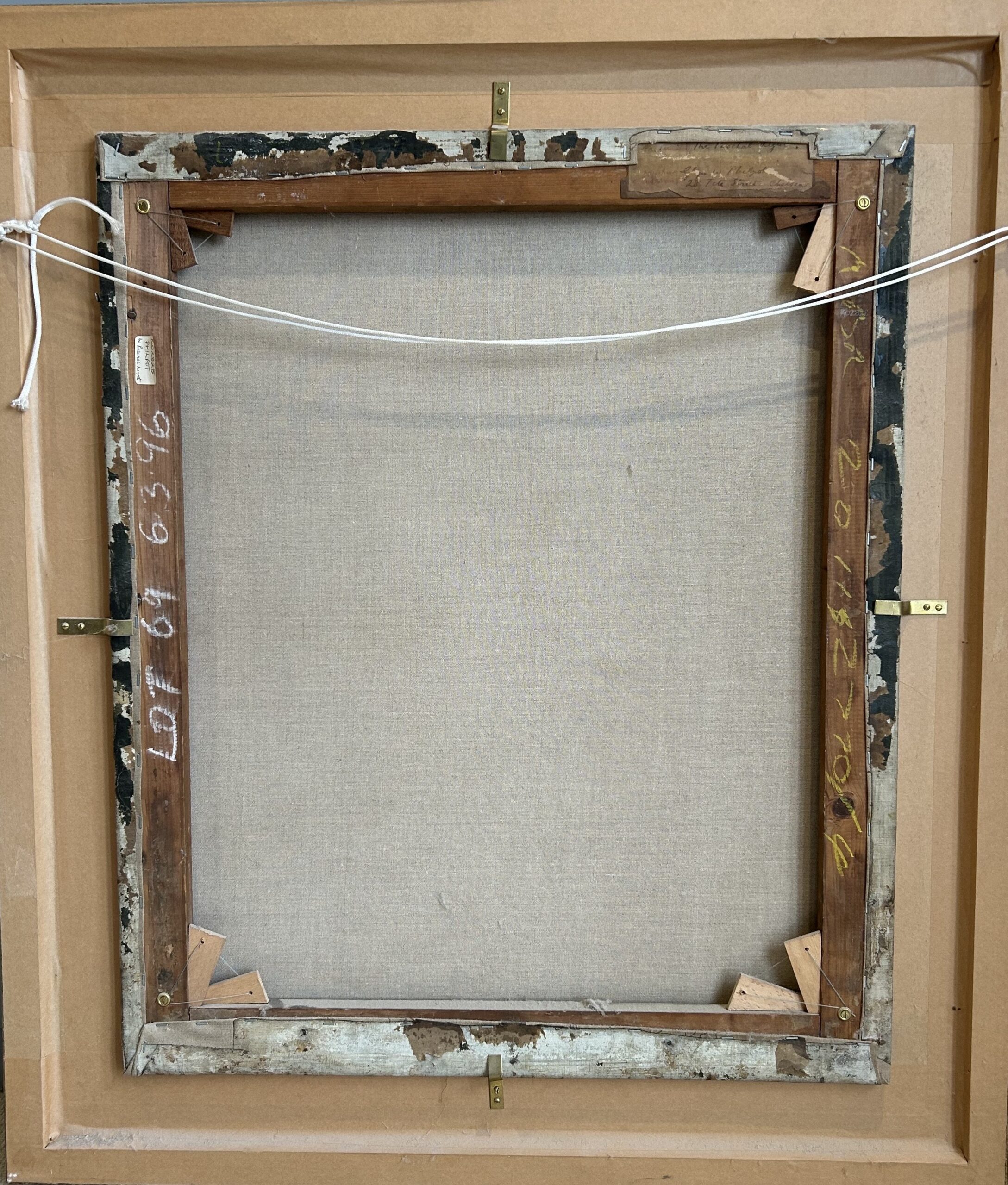
Inscribed on a label on the stretcher "The Paschal Light Glyn W Philpot 28 Tite Street Chelsea"
About the Artist
Glyn Philpot enjoyed great success during his lifetime, initially as a society portraitist. One of the leading British artists of the early 20th century, his development was very different from the others’. His style began by building on inbibed influences but progressed through becoming more personal and experimental with a wider subject range and a search for new means of expression. In 1913 he won first prize at the Carnegie International competition in Pittsburgh and he was elected A.R.A in 1915 and R.A. in 1923. He had great success as a portrait painter with a fluent style and a sensitive use of colour. His important patrons in some cases gave him commissions for more imaginative works. His output included oils, watercolours and bronzes and his style gradually became more European and modernist with a dryer, less fluid paint surface to his oils. This divergence from his earlier, classical manner did not appeal to all his previous admirers but attracted wider appreciation. In 1930 he had a one-man exhibition at the Venice Biennale. The year after his death in 1937 a retrospective exhibition of his work was held at the Tate Gallery.
About this Work
Looking upwards from the base of the Paschal Candle (the Light of Christ) towards the priests celebrating Mass at the altar beyond, Philpot uses the drama he had absorbed from Spanish art and paints with the intense involvement of a convert to the Roman Catholic church. The rising cloud of incense caught in a shaft of sunlight conjures up the cavernous interior of a great church.
The Paschal Light of 1912 was first owned by William Arkwright. In J. G. P. Delaney’s book Glyn Philpot His life and art at page 44:
“Also in 1917 Glyn illustrated Utinam: a Glimmering of Godesses, a whimsical fantasy about the adventures of a cypress tree by his patron, William Arkwright, whose portrait he had painted before the war. Arkwright was the owner of Glyn’s Paschal Light, an atmospheric church interior with candlelight and with rising incense around the priests at the altar, and Red Wine, a depiction of a young drinker in the style of his Spanish period. In representing two quite different ideas of the ‘good life’, these works suggest again that pull in Glyn between religious asceticism and sensual enjoyment. The seven watercolour illustrations for Utinam, the best of which may owe something to Bakst, are uneven in quality and are not really in Glyn’s line.”
Philpot had made his name two years before he painted Paschal Light. In response to an early fascination with Iberia and North Africa, his first visit to Spain, Portugal and Morocco occurred as soon as he had enough money, probably in the summer of 1908. He visited Seville, Madrid, Cordoba, Lisbon and Tangier. A range of new subjects opened up to him, though he was to show a sustained fondness for church interiors, such as in his 1908 painting Raising the Host in the Cathedral of Seville. (Philpot had been received into the Catholic church in 1906 when he was 22.) Other Spanish paintings were completed on his return to London including Manuelito, the Circus Boy (1909). It was with this painting that Philpot made his name when it was exhibited at the Modern Society of Portrait Painters in February 1910 and was greeted with widespread critical acclaim for its originality and technique. Manuelito was then sent to the 1910 Venice Biennale where it was bought by The Fine Art Society and sold by them to The Stedelijk Museum, Amsterdam. The culmination of this series of Spanish paintings was Zarzarrosa, a very large canvas of Spanish dancers, first purchased by Emile Mond and now in the Fitzwilliam Museum. It was exhibited at the Modern Society of Portrait Painters in February 1911 and hailed as a masterpiece.
In November 1910, in the middle of painting Zarzarrosa, Philpot made another trip to Spain. He wrote from Seville that he found the most wonderful things to paint among the singers and dancers. Another series of Spanish paintings followed. Several were shown in the autumn 1911 exhibition at the Modern Society of Portrait Painters but the present whereabouts of all of these is now unknown.
The attention which Manuelito had attracted also created much demand for Philpot as a society portrait painter. Paschal Light, therefore, was painted at a self-confident and important stage in his career.
Condition
Excellent
Provenance
Purchased from the artist by William Arkwright, a patron who had also sat to Philpot for a portrait. William Arkwright (1857-1925) was a descendant of Richard Arkwright who had pioneered developments in the manufacture of cotton. The family’s Derbyshire mansion, Sutton Scarsdale Hall, was sold by William Arkwright in 1919 and he established Thorn House in Devon, where he developed the gardens in partial imitation of his former residence.
Sotheby’s New Bond Street, 6 March 1996, lot 69.
Private collection, England.
Literature
J. G. P. Delaney Glyn Philpot His life and art Ashgate Publishing, 1999