Click any image to view full size with zoom
Thomas Frye
1710 (Dublin) – 1762 (London)
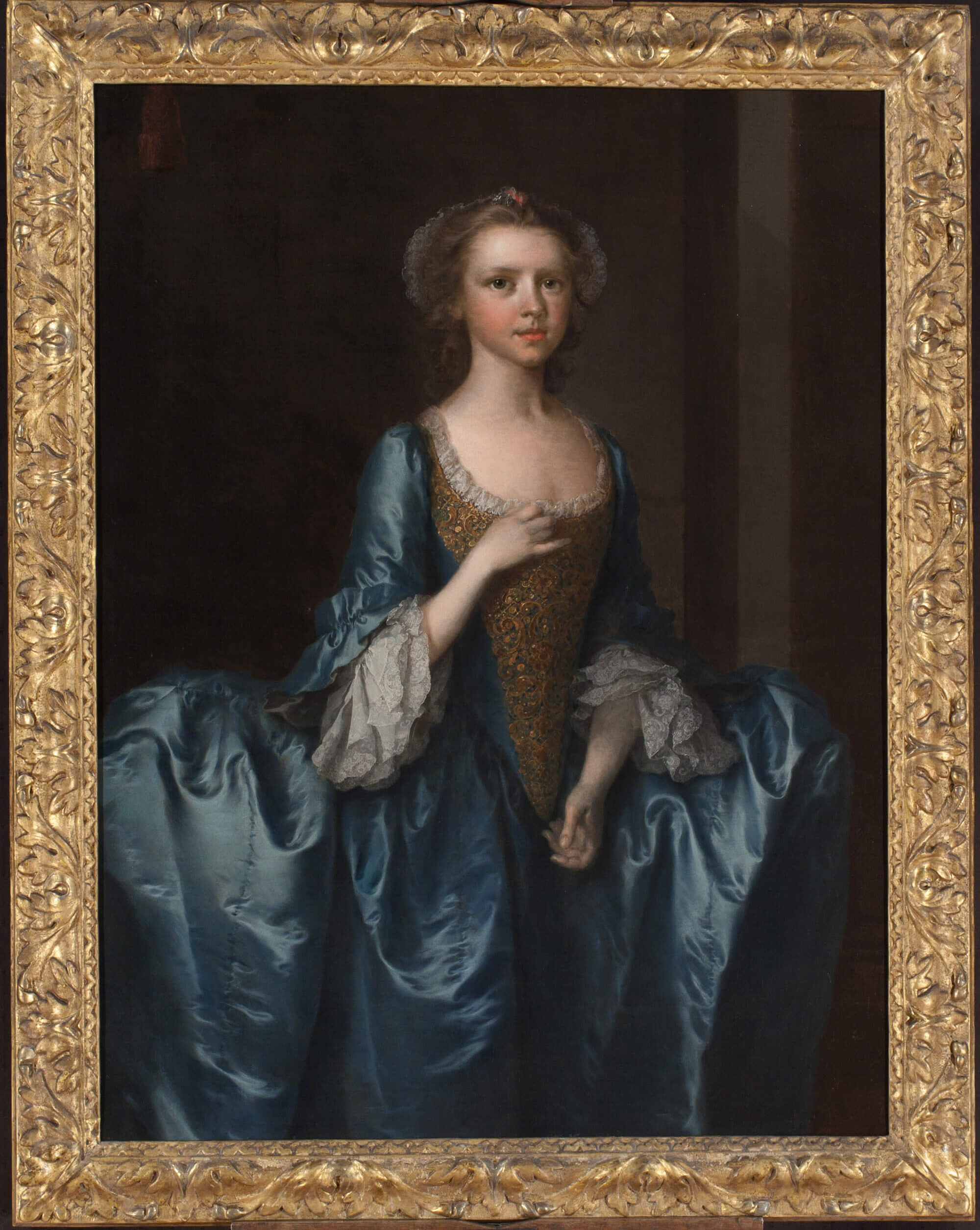
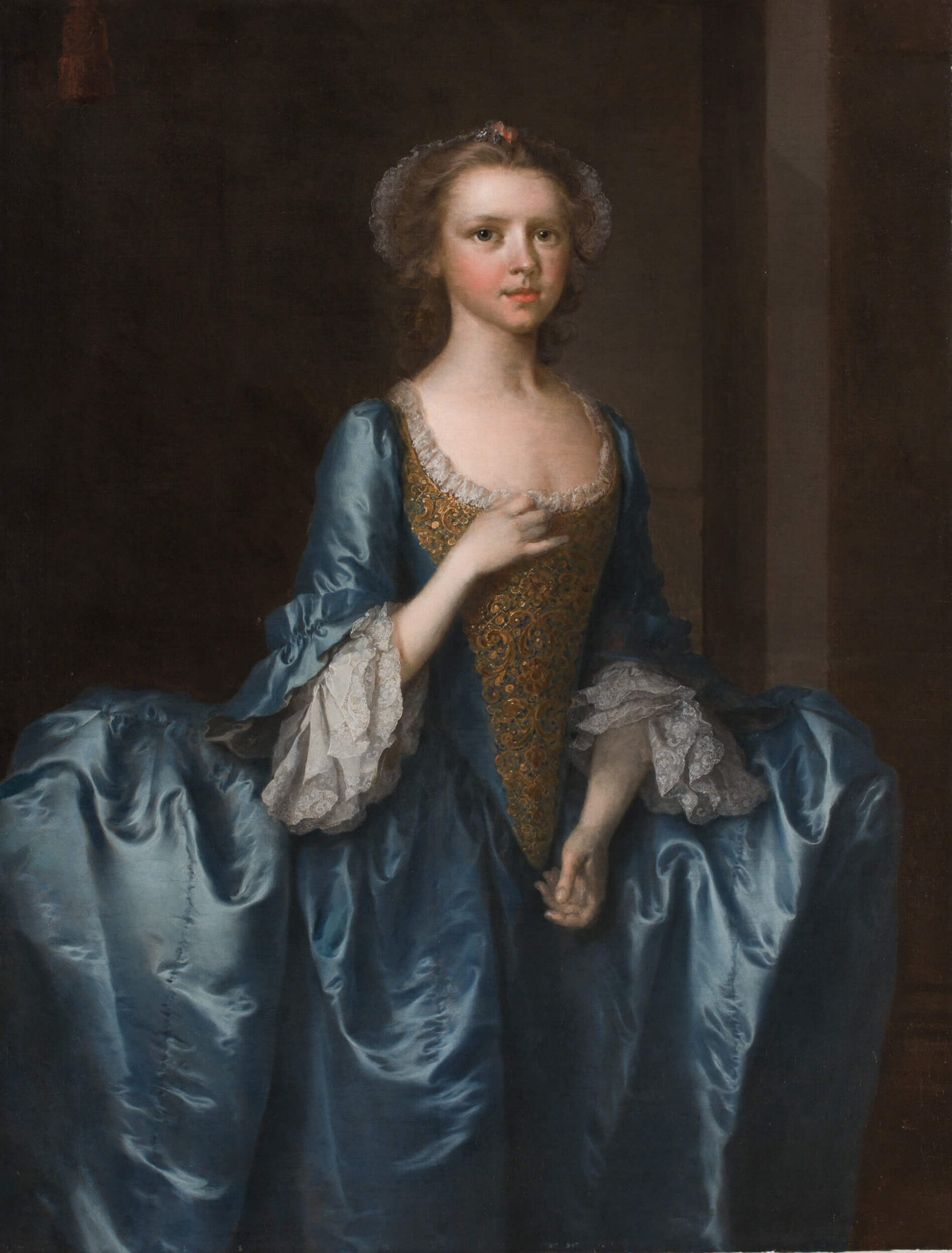
Miss Janet Gordon (1740-1779) later Mrs. John Hibbert
Painted circa 1750-52
Oil on canvas in an earlier fine English carved and gilded wood frame of circa 1680-1700
47.75 x 36.25 ins, 121 x 92 cms
Unsigned
About the Sitter
Janet Gordon (1740-1779) was the daughter of Samuel Wilkinson Gordon, a merchant of Kingston, Jamaica, and the sister of Samuel Wilkinson Gordon the Attorney General of Jamaica. From her pannier-style dress and her appearance, this portrait was painted about 1752-54 when she was 12 to 14 years of age. It would have been painted in London. On 12 June 1760, at the age of 20, she was married to John Hibbert (1732-1769) who in 1754 had taken up residence in Jamaica as a plantation owner. (By 1760 he already had two “outside families” with Dorothy Wynter and Henrietta Smith.) So the context of this painting is the mid-18th century trade with the West Indies which was generating enormous wealth. Sir Joshua Reynolds observed that elegance and refinement were the last effect of opulence and power; portraits were very much in fashion.
The Hibbert family were prosperous Manchester cotton manufacturers and merchants. John Hibbert’s father was Robert Hibbert (1684-1762). John Hibbert’s elder brother, Thomas Hibbert the eldest (1710-1780), was the first family member to settle in Jamaica, arriving in 1734. His original purpose was to protect the family’s interest as suppliers of barter goods to the slave shippers but he settled there long term, becoming Speaker of the Jamaican House of Assembly in 1756. He seems to have had a sufficiently robust constitution to survive the unhealthy climate in which many foreigners succumbed to disease, in particular yellow fever.
Janet bore John Hibbert three sons and two daughters: Thomas junior (1761-1807); Cecilia; Margaret; John (1768-1855) born in Manchester; and Robert junior (1769-1849) born in Jamaica. This last was born after his father’s death in Jamaica in 1769 at the age of 37. At first Janet remained in Jamaica where she had a passionate affair with Dr. David Grant, who had probably been her husband’s doctor. In 1771 she came to England and lived in Mortlake. She died in 1779 aged 39, possibly of malaria. She was probably not in good health for some time previously because she made her will on 27 December 1774. In a codicil to her will made on 8 October 1778 she requested Mrs. Abigail Hibbert, wife of Robert Hibbert of Manchester, and Mrs. Arabella Sprigg of Barnes, widow, [the widow of Nathan Sprigg of Barnes, the family’s lawyer] to take care of her daughters, and her brother Samuel Wilkinson Gordon to take care of her two younger sons John and Robert. Thomas junior and Robert (later the founder of the Hibbert Trust) returned to Jamaica after education in England.
By her will Janet Hibbert left her “plate, furniture, etc.” to her two daughters Cecilia and Margaret. This portrait may or may not have passed to them. If not, it most likely passed to her eldest son Thomas Hibbert junior. Either way, by the mid-19th century it was in the possession of Thomas Hibbert junior’s son, Captain John Hubert Washington Hibbert.
After his return to Jamaica, Thomas Hibbert junior (of Agualta Vale and 24 Upper Wimpole Street) sold his interest in the family slave factoring business and used the proceeds to buy out his uncles’ plantation interests. He married Dorothy Mansfield, daughter of J. Rushton Mansfield of Kettering, Northamptonshire in 1792. By his will he left “To such of my sons who will first attain 25 all my plate, jewells, books, pictures, etc.”
Captain John Hubert Washington Hibbert (1803-1875) of Bilton Grange, Warwickshire and Dover Street, Piccadilly was their son: see below in the Provenance for this portrait. He did have an elder brother, Thomas, who lived with him and was in a deed of 1839 described as a lunatic. Captain Hibbert married Lady Julia Mary Magdalen Talbot (née Tichborne) (?-1892) in 1839 at the Catholic Chapel, Spanish Place. She was the widow of Lt. Col. Charles Talbot, brother of the 15th earl of Shrewsbury, whose son by this marriage succeeded as 17th earl in 1852. Lady Julia was a Roman Catholic and at that date there were no Catholic churches in Rugby or Coventry. It was for her that Captain Hibbert commissioned the building of St. Marie’s Church Rugby to the designs of A. W. N. Pugin. He remained its benefactor and he and his wife are buried there, Captain Hibbert having converted to Roman Catholicism some years earlier. Their son, Major Paul Edgar Tichborne Hibbert (born 1846) of Ashby St. Ledgers, Northamptonshire and Braywick Lodge, next inherited the present portrait. He married Charlotte Julia, daughter of William Gerard Walmesley of Westwood Hall, Lancashire and Caroline de Trafford-Trafford.
Captain John and Lady Julia also had a daughter, Cecilia Elizabeth Tichborne Hibbert, who married Sir Charles Henry Tempest in 1862. They are two of the great-great grandparents of the 18th duke of Norfolk.
Dr. David Grant (born 1744) was a Scottish doctor who practised medicine in Jamaica although he later returned to England and lived in Harley Street. He married Anne Hitchman. His writings included An Essay on the Yellow Fever of Jamaica which was published in London in 1801. It seems that he was both the family doctor and a family friend of John and Janet Hibbert and that he remained a family friend after his affair with Janet. Thomas Hibbert junior, Janet’s eldest son, by a codicil to his will dated 27 January 1806, left “to each of the three elder sons of Dr. David Grant of Kingston £50”.
About the Artist
Thomas Frye was born in Dublin in 1710 and settled in London about 1734. Little is known of his training although his early work shows the influence of the Tipperary portrait painter James Latham and of Stephen Slaughter. Neither is it known how he came to London. He seems to have established a good reputation as a portrait painter by 1736 when he was commissioned to paint a portrait of Frederick, Prince of Wales, for the Company of Saddlers. There are a number of known portraits by Frye painted between 1738 and 1744, mostly three-quarter length.
In 1744 Thomas Frye was the first British subject to discover the secret of making porcelain. He was a founding partner and first manager of the Bow porcelain manufactory. With Edward Heylyn he took out a patent for a new method of manufacturing china on 6 December 1744 in the parish of Bow. He was living at West Ham, a short distance away from the factory. On 17 November 1749 Frye took out a second patent alone, and it has since become apparent that some of the early works from Bow were from Frye’s own designs. During this period he continued to paint portraits in oil and produced some of his finest works, such as Mr Crispe, of Quex Park, Thanet, signed and dated 1746 (Tate collection); Benjamin Day and Mrs Benjamin Day (1751; private collection). The present portrait, previously unrecorded as it had remained with the family since it left Frye’s easel, must have been painted circa 1750-52.
Frye’s dedication to production processes at the factory and his close supervision of porcelain designs left him completely debilitated. In 1759 he went to Wales to restore his health. The factory did not long survive his departure. Esteemed and respected by all who knew him, Frye died relatively young of consumption on 2 April 1762 at Hatton Garden, and was buried in Hornsey churchyard, Middlesex. He left a wife and two daughters, both china painters at Bow. (from Michael Wynne’s article in the Oxford DNB).
Frye’s premature death was a great loss to British portrait painting. His skill developed early and his surviving works are original and highly accomplished, his sitters at ease on the canvas and their characters well conveyed. His passionate involvement in the processes of porcelain making, with exposure to toxic materials, left a legacy in terms of the history of English ceramics but curtailed his further potential achievements in the field of painting. After 1759 he produced editions of mezzotint portrait prints and individual drawings, all distinguished by the dramatic use of light. This work influenced the paintings of Joseph Wright of Derby.
Provenance
- By descent from the sitter to Cecilia or Margaret Hibbert or (most likely) Thomas Hibbert junior.
- His son, Captain John Hubert Washington Hibbert (1805-1875) of Bilton Grange, Warwickshire; by whom inscribed on the reverse of the stretcher “Grand Mama Hibbert sent to Bilton Grange from John Hibbert Esq., Trinity Coll. Camb. & St. [ ? ] Novr. 1855 No. 5”. J.H.W. Hibbert had first rented Bilton Grange in 1839 with his widowed mother Dorothy (nee Mansfield) and his elder brother Thomas who was described as a lunatic. He purchased Bilton Grange in 1846.
- To his eldest son, Major Paul Edgar Tichborne Hibbert J.P. of Ashby St. Ledgers, Northamptonshire. His possession of the portrait is recorded in Caribbeana, volume IV, published in London in 1916, illustrated and captioned on page 193. The illustration shows the portrait in a different frame; it presumably acquired its present frame (which dates from 1680-1700) after this photograph was taken.
- By family descent until 2011.
Exhibited
Neglected Genius: Thomas Frye, an Irish artist in London
Dublin Castle 1st December 2023 – 19th March 2024
Catalogue no. 9 (illustrated)
Literature
- Caribbeana, volume IV, London 1916, page 193.
- Michael Wynne articles on Thomas Frye.