Click image to view full size with zoom
Marcus Gheeraerts the Younger
1561/2 (Bruges) – 1636 (London)
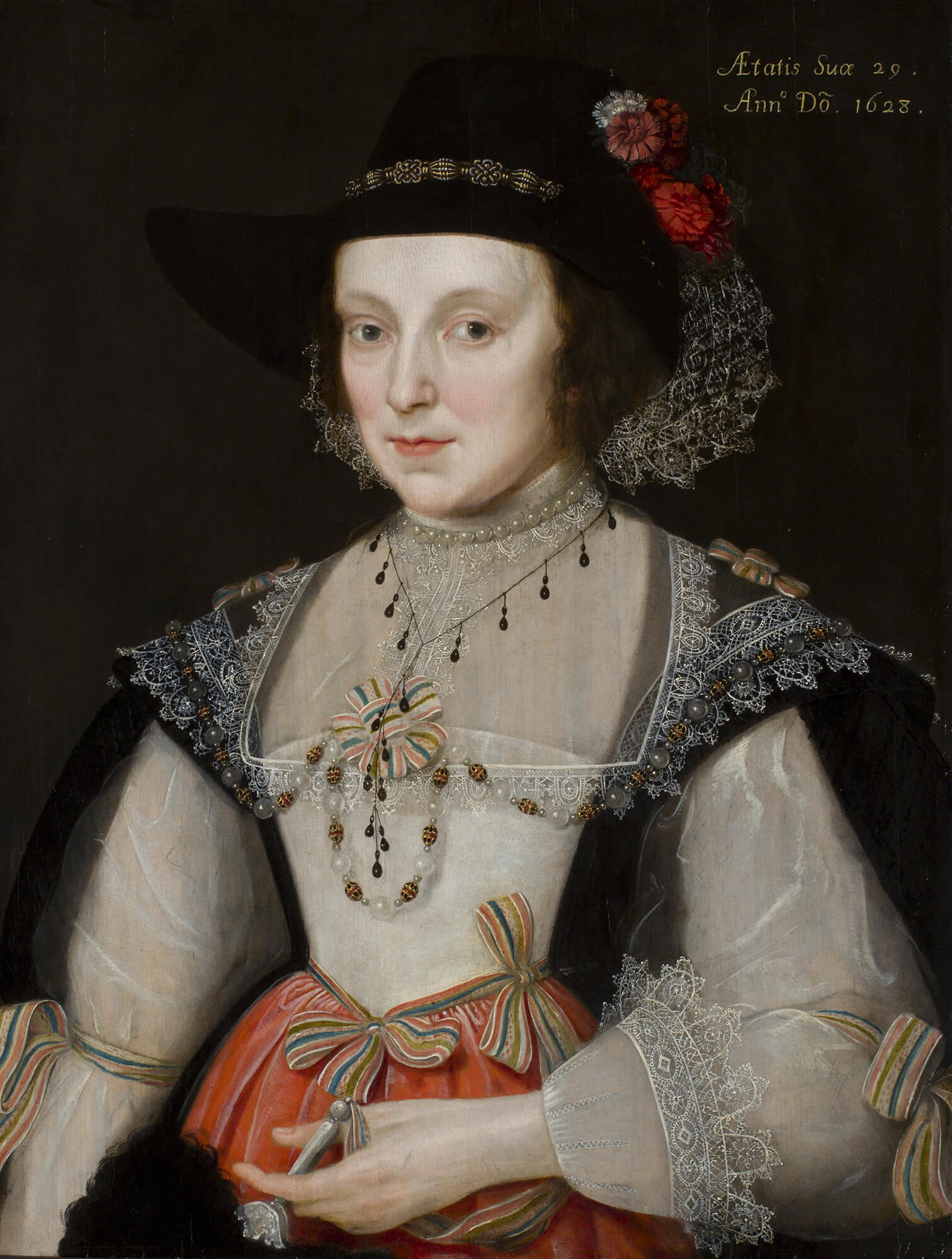
Lady Frances Devereux (1599–1674), Lady Beauchamp, later Marchioness of Hertford and Duchess of Somerset
Dated top right 1628
Oil on oak panel
26 5/8 x 20 ½ ins, 67.6 x 52 cms
Inscribed by the painter top right with the sitter's age and the date
About the Sitter
This is an important rediscovered half-length portrait of Lady Frances Devereux at the age of 29.
She was born on 20 September 1599 at Walsingham House, Seething Lane in the City of London. Her parents were Queen Elizabeth’s favourite Robert Devereux, 2nd. Earl of Essex (1565-1601) and his second wife Frances (1567-1632) daughter of Queen Elizabeth’s puritan secretary Sir Francis Walsingham and widow of Sir Philip Sidney the protestant poet and military hero. She was their youngest child, her surviving siblings being Robert Devereux, 3rd. Earl of Essex, and Dorothy Devereux.
On 3 March 1616/17 at Drayton Basset, aged 18, she married William Seymour (1587-1660) 1st. Marquess of Hertford and 2nd. Duke of Somerset. He was the second, but eldest surviving, son of Edward Seymour, Lord Beauchamp (1561-1612) and his wife Honora Rogers (who was Edward’s cousin, the daughter of Andrew Rogers and Mary Seymour and the granddaughter of the 1st. Duke of Somerset). He was the grandson of Edward Seymour, 1st. Earl of Hertford, and his first wife Catherine Grey.
Echoing the vicissitudes of his grandfather Edward, William Seymour had in 1610 made an illicit first marriage to King James I’s cousin Lady Arabella Stuart (1575-1615). The King was displeased as the two parties were cousins and each had a remote claim to the throne. They were both imprisoned but escaped in 1611 and, while Lady Arabella was recaptured and imprisoned in the Tower, Seymour fled and lived in exile in France. He returned to London in 1616, shortly after Lady Arabella’s death in the Tower in 1615. Partly as a result of this early scandal, he never gained high office. He was on very close terms with his brother-in-law Robert Devereux, 3rd. Earl of Essex, another peer marginalised from the court. Although Hertford was an active politician, at first opposing King Charles I in parliament and then becoming a royalist army officer, he kept his distance from the court and tried to promote a negotiated settlement with parliament. Having been a powerful figure in the 1640s, he maintained a low profile during the Commonwealth, avoiding involvement in royalist conspiracies. He spent much time at home on his estates. Clarendon described him as a man of very good parts, erudite and “so wholly given up to a country life, where he lived in splendour, that he had an aversion, even an unaptness, for business”. He lived to be among the peers who welcomed Charles II at Dover in May 1660. The following September he was restored to the dukedom of Somerset by a private act of parliament.
Lady Frances bore Hertford seven children. In this portrait painted 11 years after her marriage she appears as a strong and successful lady. One may speculate that her home life with Hertford was happy and a respite from a difficult childhood. Her father had been beheaded for alleged treason in 1601 when she was not yet 2 years old. Her mother had promptly married her lover Richard Burke, 4th. Earl of Clanricarde and had initially gone to live in the west of Ireland: she was already banned from court because she had married both Sidney and Devereux without the Queen’s knowledge or consent. Although on his accession King James restored the titles and estates of Lady Frances’ brother Robert, her brother did suffer a series of personal and political problems. Later, living on his estates at Chartley in Staffordshire, Robert oversaw the marriages of Frances and her sister. He remained a close friend of Hertford.
Lady Frances died on 24 April 1674 and is buried with her husband at Bedwyn Magna church, Wiltshire.
About the Artist
Since the mid-20th. century there has been much research on early English portraiture, greatly assisted by the cleaning and scientific analysis of many works which were previously obscured by grime, discoloured varnish and overpainting. Earlier attributions have frequently been revised. The present portrait was in 1802 sold as a work in the style of van Dyck and was in 1928 attributed to Gilbert Jackson. Now, however, it can confidently be said to be the work of Marcus Gheeraerts the younger, who was born in Bruges 1561/62 and died in London in 1635/36. The lettering of the inscription is original and in Gheeraerts’ distinctive style found on signed and authenticated paintings. There are close similarities, both in terms of composition and dress, with the artist’s last known signed work, the portrait of Anne Hale, Mrs. Hoskins, painted in 1629. The technique of the present portrait accords with Gheeraerts’ hand.
Marcus Gheeraerts the younger had arrived in London in 1568 when his father Marcus the elder (c.1520–c.1590), an engraver and painter, settled there after leaving Bruges to escape religious persecution. The family lived as part of a community of intellectually distinguished Netherlandish exiles. Marcus the younger became one of the leading society portrait painters of his time. In 1619 he gained denization, after which he is thought to have become a member of the Painter-Stainers’ Company. By that date, however, he was being supplanted in Royal favour by the new wave of Netherlandish-trained portrait painters, primarily Paul van Somer and Daniel Mytens, who had come to the Jacobean court between 1616 and 1618, In consequence, from about 1620 Gheeraerts’ sitters were progressively less court orientated.
The 2nd Earl of Essex, the father of the sitter in this portrait, had deliberately cultivated his public image as part of his struggle with the Cecil family for political power. He was charismatic and popular with the people. He used portraiture to commemorate important events in his career and to be present on the walls of his allies’ houses. In this Gheeraerts was his artist of choice and surviving examples include a three-quarter length (Trinity, Cambridge) and a full-length (Birmingham Museum). For portrait miniatures Essex seems to have changed his preference from Nicholas Hilliard to the French-born incomer Isaac Oliver who was to become Gheeraerts’ brother-in-law in 1602. Gheeraerts was therefore very much the painter of the 2nd Earl of Essex and his circle and was also patronised by William Seymour. Attributed to him is a full-length portrait of William Seymour’s first wife, Lady Arabella Stuart, at Temple Newsam, Leeds. He painted a full-length of Lady Frances in 1616, probably as a marriage portrait.
Further Information
Traditionally this portrait has been described as a portrait of Lady Holderness and since the 19th. century had been to represent Martha Cokayne (1605–1641), third daughter of Sir William Cokayne of Rushton (1561-1626), first Governor of Londonderry and Mayor of London in 1619/20. Martha became the second wife of John Ramsay, Earl of Holderness (c. 1580-1625). Following his death, Martha married secondly, in 1627, Montagu Bertie, 2nd Earl of Lindsey (1608-1666) who was a direct ancestor of the 1st Viscount Wimbourne. This is presumably the reason why Lord Wimbourne bought this portrait in the 19th century. Martha was, however, baptised in 1605 and since it is likely that this took place in the year of her birth she was too young to be the sitter in this portrait.
That the painting has traditionally been described as a portrait of Lady Holderness is, however, consistent with its new identification and explicable by a confusion of two creations of the earldom of Holderness.
The eldest daughter of Lady Frances and William Seymour was Frances Seymour. In 1676, as her third husband, she married Conyers Darcy, 2nd. Earl of Holderness (1621/22-1692). She was the third of his four wives. She died in January 1680-81 and was buried in Westminster Abbey. His fourth marriage took place in 1684/5. Her mother had died in 1674 and the present portrait is likely to have passed to her shortly after that event. It is easy to understand that the picture belonging to Lady Holderness (Lady Holderness’ portrait) came to be described by later generations as a portrait of her rather than her mother, especially as she died without children by Conyers Darcy (or by either of her two previous husbands). Moreover, the fact that this description was given to it corroborates the theory that it descended through her.
The main confusion has, though, been about the sitter’s family. This is because there were in fact three creations of the Holderness title. John Ramsay (c. 1580-1625) was an important Scottish aristocrat and the first favourite of King James I when he became King of England in 1603. He married his first wife, Elizabeth Radcliffe, at Whitehall Palace but in December 1618 she died of smallpox. None of their children survived to adulthood. He was created 1st Earl of Holdernesse on 22 January 1620/21. His second wife, Martha Cokayne, was married to him in July 1624. They had no children and he died in 1626. The line then became extinct.
The third creation was when Conyers Darcy, the father of Frances Seymour’s husband, was created 1st Earl of Holderness on 5 December 1682.
Lady Frances Devereux was born in 1599, which corresponds with the inscription on the portrait, and other images of her (including a later portrait by van Dyck which is on long-term loan to the National Trust, Plas Newydd) are consistent with this identification.
Provenance
- Probably by descent from the sitter to her daughter Frances Seymour, on whose death it passed to her husband…
- Conyers Darcy, 2 Earl of Holderness. He was succeeded in 1692 by his grandson…
- Robert Darcy, 3 Earl of Holderness. He was succeeded in 1721 by his son…
- Robert Darcy, 4th Earl of Holderness. On his death in 1778 the earldom became extinct (although the baronies of Darcy and Conyers devolved on his daughter Amelia Osborne, Marchioness of Carmarthen who died in 1784 aged 29). His wife lived until October 1801.
- There was a sale of the art collection of the late countess of Holderness in 81 lots at Christie’s on 6 March 1802. The present painting was probably lot 3 in the catalogue, described as “In the style of van Dyck. A lady’s portrait.” Bought Borrowdale, 3gns.
- With Mr. Morant (George Morant 1770-1846), picture framer and collector. The painting was not included in the sale of George Morant’s personal collection by Phillips on 18, 19 & 21 May 1832; either it had been sold previously or it may have remained with his son George John Morant (1799-1865) who continued his business.
- Ivor Churchill Guest, 1st Viscount Wimborne (1873-1939), Canford Manor, Dorset
- By whom sold at Sotheby’s London, 18 July 1928, lot 62A for 32 gns to Moore (as by Gilbert Jackson)
- With Ferargil Galleries, New York, pre 1955
- By whom sold to Casson Galleries, Boston
- Sotheby’s London, 5 July 2012, lot 196
Literature
- A Catalogue of the pictures at Canford Manor, privately printed 1888, page 82, no. 197
- Roy Strong. Elizabethan Painting: An Approach Through Inscriptions-III Marcus Gheeraerts the Younger, Burlington Magazine, vol 105 no. 721, April 1963, page 149-50, 157 & 159; and supplementary article by Sir Oliver Millar.
- Karen Hearn Marcus Gheeraerts II Tate Gallery exhibition catalogue, London, 2002.