Richard "Beau" Nash
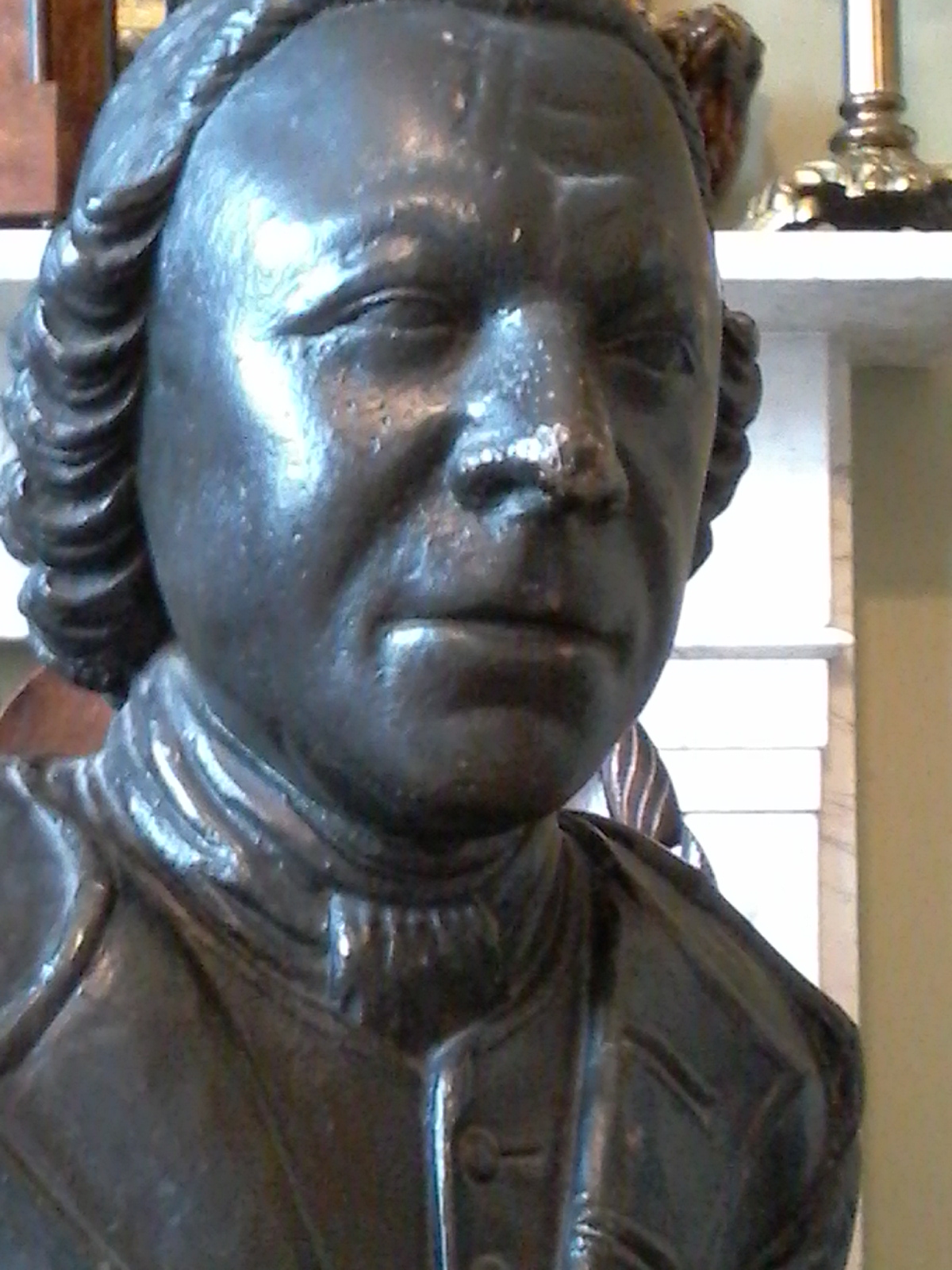
Wood bust
Click any image to view full size with zoom
Adriaen Carpentiers
active 1739 – 1775/6
John Wood the elder Baptised 26 August 1704 (Bath) – died 23 May 1754 (Bath)
Circa 1745
Oil on canvas, in its original frame
29 x 24.5 ins, 75 x 62 cms.
Unsigned
About the Sitter
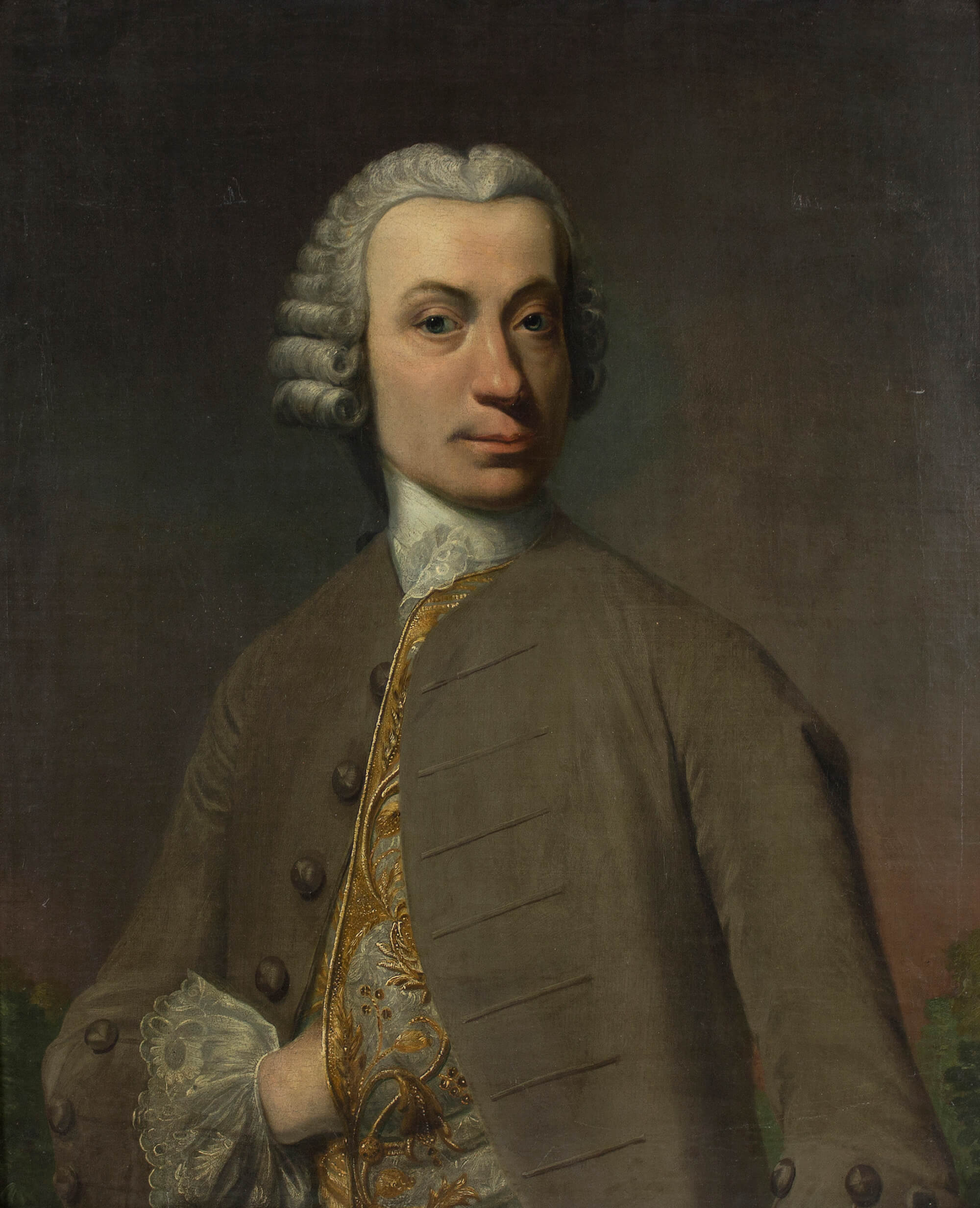
In or about 1745 Carpentiers painted both John Wood and Beau Nash, two of the most transformative men in Bath. Beau Nash was noted for his floral waistcoats and the elaborate version worn by Wood in this portrait might have come from the same maker. A more significant similarity is that they were both key players in this era of Bath’s Georgian renaissance. The visits of Queen Anne in 1702 and 1703 had led to an enormous rise in Bath’s popularity. A few years later the small, medieval city was being overwhelmed, its buildings too few and inadequate for the accommodation and entertainment of fashionable visitors, its social events unorganised and conduct unregulated. Nash is traditionally believed to have arrived there in 1704-05 and to have been appointed as Master of Ceremonies in Bath between 1705-08. He was made an honorary freeman of Bath in 1716. By the early 1740s he had reached the most powerful point of his career. He had invented himself. He was a combination of personality, self-assurance and vision who also had sympathy and respect for individuals.
Wood’s genius was different from that of Beau Nash. He was Bath’s first real architect. He was also a visionary in both his plans for Bath’s future and his imaginings of its ancient past. In practice, he had to overcome intense competition to prove himself. This involved compromising many of his ambitious ideas in complex negotiations to obtain land, permissions and financial backing. From early projects in the 1720s, Queen Square was built between 1729-36 and the Parades in the 1740s. In 1754 the cornerstone of the first house in The Circus was laid but Wood died three months later and the project was completed by his son, John Wood the younger (1728-1782).
So Carpentiers’ two portraits were of men who were achievers, painted at a time when Bath was at its height as a social hub whilst also a building site. Who commissioned them? It is likely that they were both painted for the sitters themselves. Nash’s portrait was bequeathed to the Victoria Art Gallery in Bath by Councillor William Lewis in 1900. Wood’s portrait has no early provenance but could have remained with his descendants for many years.
There are no other known portraits of John Wood the elder. The only painted representation is as part of the conversation piece “The Four Bath Worthies” painted about 1735 by an unknown painter who was not a portraitist. Wood’s features in this representation do suggest the same sitter as in the present portrait (painted eight years later) but the quality of The Four Bath Worthies is not by itself good enough as the basis for a firm identification.
On 9 and 10 May 1996, Sotheby’s held a sale of the personal collection of Tristram Jellinek, actor and antique dealer, who had died the previous year. Lot 647 was a carved wooden bust 27 ins. high. Probably made of pine, it had originally been painted the colour of Bath stone and later (possibly in the 19th century) overpainted with a black/bronze colour. On the reverse of the socle it is inscribed:
“ J. Wood
1767
Aged 49 “
Wood the elder died aged 49 in 1754. At the time of the sale, however, Sotheby’s thought the bust represented John Wood the younger because of the 1767 date in the inscription (in spite of the fact that in 1767 the younger Wood would have been aged 39).
Subsequently this was researched by Dr. David Wilson who established that it was in fact a bust of the elder Wood. In synopsis, his case is this. The face shows none of the liveliness typical of busts of living subjects. Dated 1767 as the date of its carving, it must have been based on a face mask cast from a mould taken off the face shortly after death. While the best portrait sculptors might be able to restore more lifelike features when working from such a model, all the indications in the present case suggest that the bust was fashioned by someone who “is unlikely to have been more than an averagely competent carver in wood”. He suggests the carver “might have been a carver of objects such as ships’ figureheads at the nearby commercial seaport of Bristol, many of which by that time were made of softwoods, often pine”.
Dr. Wilson notes that the eyes of the bust are small, “doubtless reflecting the small eye sockets in the face mask”. There is no attempt to depict ears, unlikely to have formed part of the mask, but the carver has taken great care to reproduce all the small pock marks and other ravages left by 18th century life on the face, as if faithfully following a precise pattern.
Dr. Wilson’s investigations also found something akin to the Holy Grail in terms of portrait research. This is John Wood the elder’s description of himself made in 1751, less than three years before his death and approximately six years after Carpentiers’ portrait.
Wood had been appointed as architect for the new Palladian exchange built in Bristol between 1741-1743. Its success led Bristol’s great rival, Liverpool, to commission Wood in 1749 to design a combined exchange and town hall. In July 1749, more than two months before the first stone of the new exchange was laid, both Wood and his son were made Freemen of the City of Liverpool.
While in Liverpool engaged on this project, Wood seems to have been a member of a sociable society called “The Most Honourable and Facetious Society of Ugly Faces”. Rule 2 required that, to qualify for membership, a candidate must have “something odd, remarkable, droll or out of the way in his Phiz; as in the length, breadth or narrowness thereof, or in his complexion, the cast of his eyes, the make of his mouth, lips, chin, &c.”.
An entry in the club records dated 22 July 1751 referred to a member John Wood, “of Liverpool, Architect” and described his qualification for membership as:
“A stone colour’d Complexion. A Dimple in his Attick Story. The Pilasters of his face fluted, Tortoise ey’d, a prominent Nose, Wild Grin, a face altogether resembling a badger, and finer tho’ smaller, than Sir Chrishr Wren or Inigo Jones’s”.
Dr. Wilson comments that there are certain aspects of this description that bear a remarkably close similarity to the face in the wooden bust. The painted image also picks up the mention of Wood’s complexion, accounted for by the fact that he was seriously asthmatic. Wood’s wry, unvarnished description of his own unorthodox face comes to life in front of the Carpentiers portrait.
About the Artist
Adriaen Carpentiers arrived in England from Flanders in 1739. He seems to have worked as an itinerant portrait painter until he settled in London in the 1760s.
The first three recorded portraits, dated 1739, are of sitters who lived in the same area. Two were painted at Bradbourne, Kent and represent:
Lt. Col. Thomas Twysden (1710-1784) in scarlet cloak and waistcoat trimmed with gold lace, with white cravat. Oil on canvas 30 x 25 ins. Signed on reverse A. Carpentiers and dated 1739. [illustrated in Kent Archaeological Society catalogue & Heinz Archive]
Sir William Twysden, 6th. Bart. of Roydon (1707-1767) in blue velvet coat and red waistcoat, trimmed with gold lace. Oil on canvas 30 x 25 ins. Signed on reverse A. Carpentiers and dated 1739. [illustrated in Waterhouse, British C18th. Painters, page 70]
The third sitter was a distant relation of the Twysden family. This is Sir Francis Dashwood (1708-1781) wearing a fashionable decorated waistcoat. Dashwood had taste and was very well connected so he would have been a useful patron. In the Heinz Archive there is a 1753 mezzotint of this portrait by John Faber Jr. giving the date of the painting as 1739. It must have been painted shortly before Dashwood left for Italy, not returning until 1741. Carpentiers resumed working for him at various times after that until his 1761 portrait of Dashwood.
The present portrait is very similar in style to the 1739 paintings and also to the portraits Carpentiers painted in Oxford in 1745. It is less like his c.1742 images of Dashwood and others in dress as members of the Divan Club which were not conceived as conventional portraits. Similarly, Dashwood commissioned Carpentiers in the early 1750s to paint him dressed as Pope Innocent III in a portrait associated with the Hellfire Club.
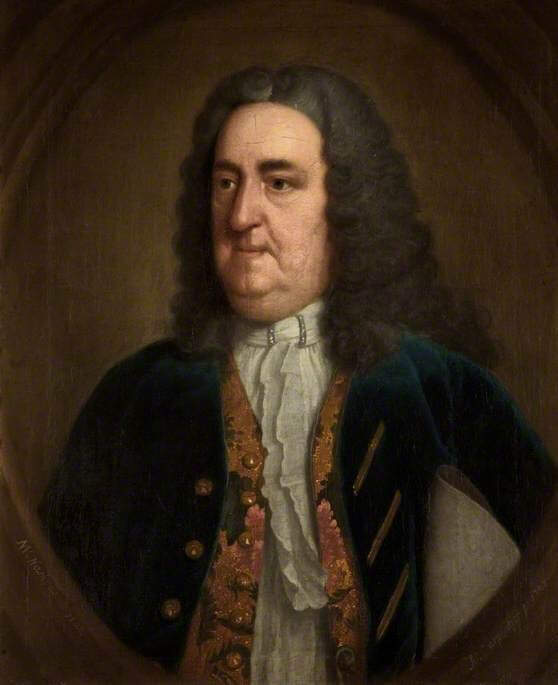
Possibly it was Dashwood who suggested in the early 1740s that the talented Flemish portrait painter should try his luck in the fashionable company at Bath. Between 1743 and 1745 Carpentiers was in Bath where he painted Richard “Beau” Nash. This portrait is inscribed on the reverse:
“ Mr Nash age de 71 ans
A:Carpentiers p. 1745 “
The painting not only locates Carpentiers at this date but it demonstrates his skill at capturing a characterful likeness of a prominent and complex sitter. See the image above of his 1745 portrait of Nash in a long wig.
It is believed that the portrait of John Wood dates from this period, perhaps the same year as that of Nash.
Further Information
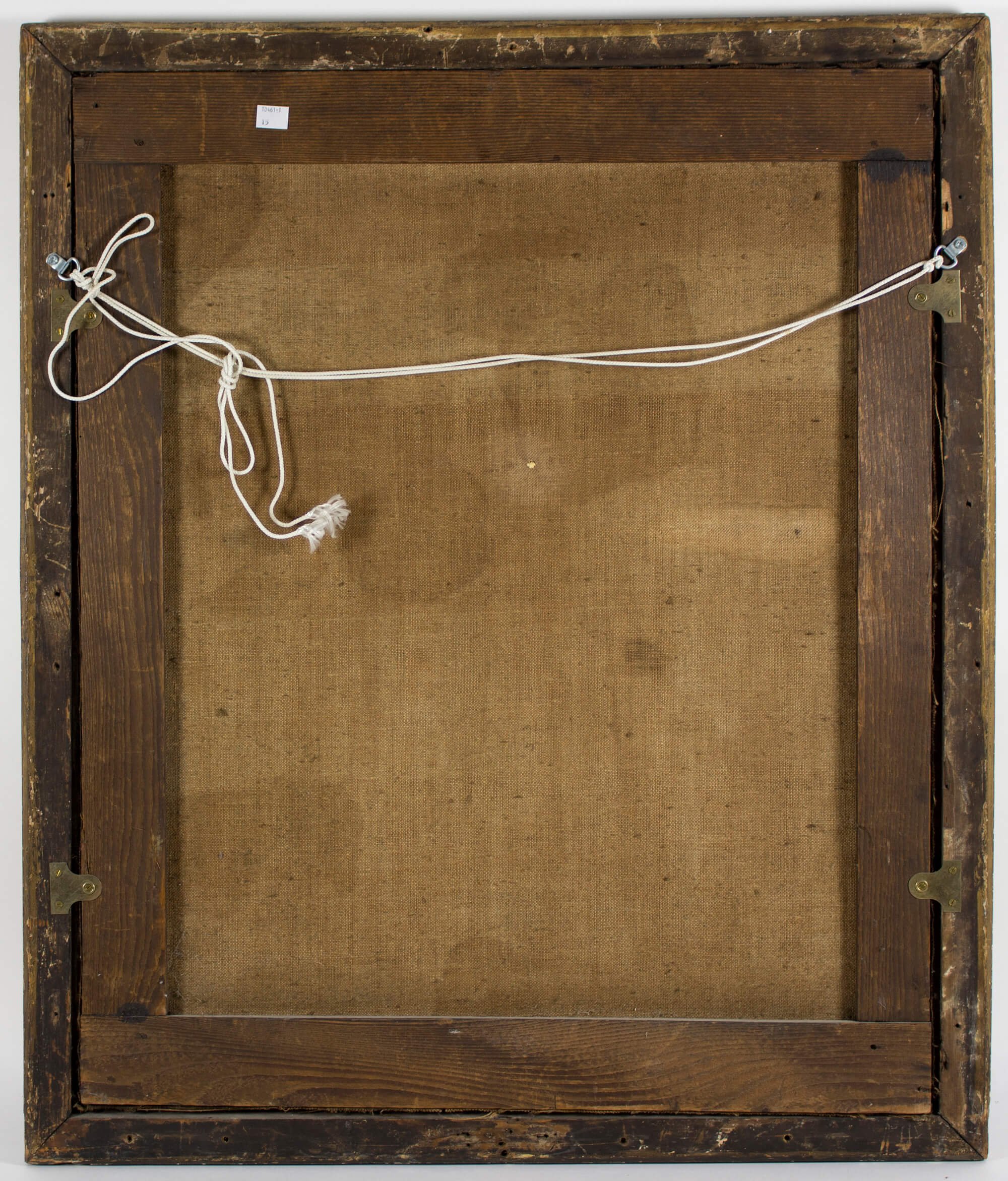
The canvas has been lined but is on its original stretcher.
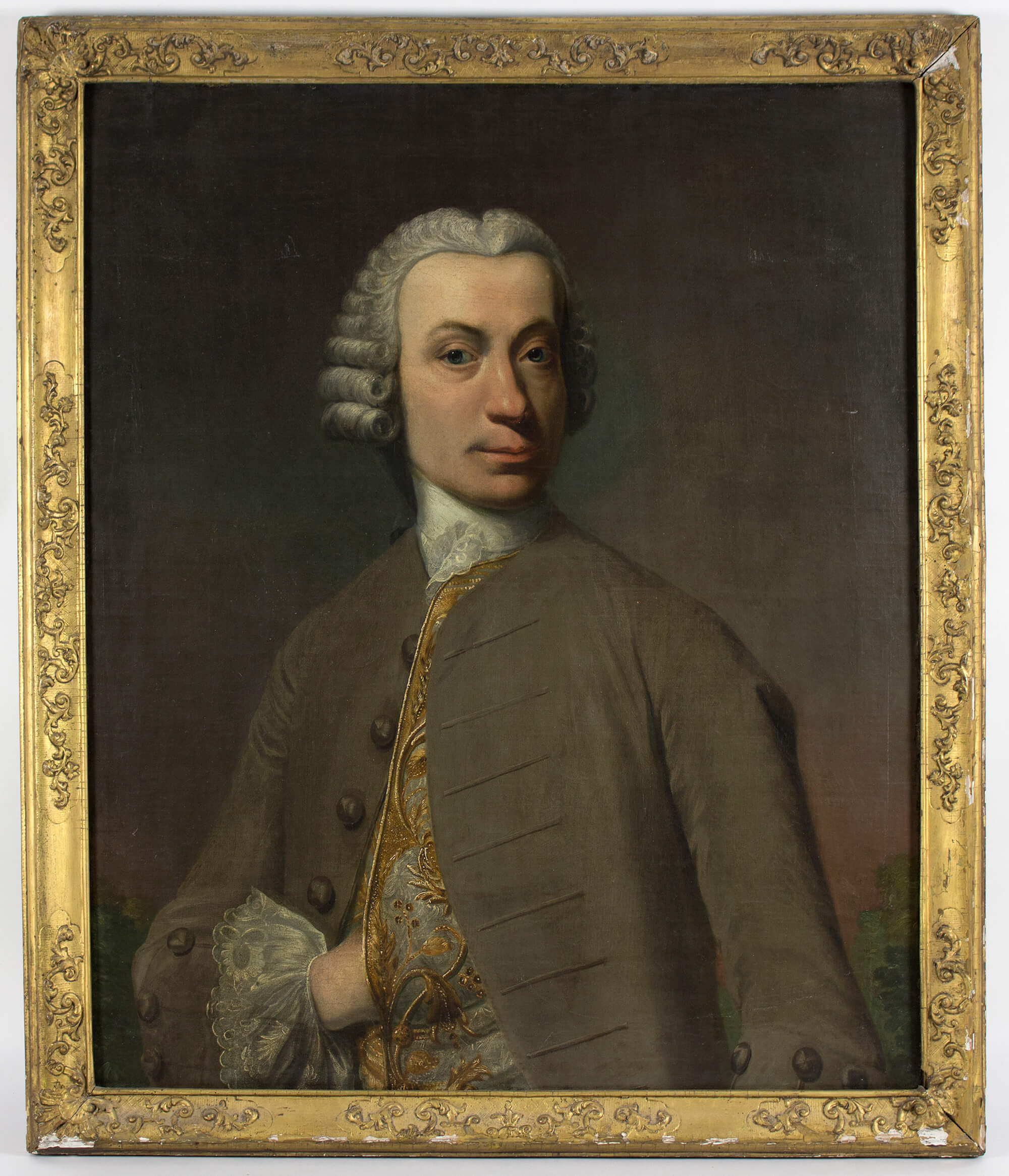
The frame is original. It is narrow and decorated with detailing correct for a 1740s carved frame but it is a composition frame, very unusual for that date. Possibly it was made by an immigrant frame maker.
Provenance
Probably commissioned by the sitter.
He had married Jane Chivers in about 1727. They had eight children of whom four survived to adulthood.
On his death, probably to his eldest son John.
In 2016 David Crellin presented his research into Wood’s descendants to a meeting of the History of Bath Research Group. He had identified 1347 descendants of whom at least 500 were then still alive. A number of these were aware of Wood as an ancestor although they did not bear the same name. It is therefore entirely possible that the portrait descended in the family for several generations. Some branches of the family died out, others entered poverty. So it is near impossible to speculate on when the painting might have been sold outside the family.
In 2018 it was sold at auction in Gloucestershire, without names for artist or sitter. The auctioneer questioned the vendor, who said that it had been bought in the Cotswolds many years previously but could not find any further details.
Literature
D. Wilson, A rare portrait of the architect and town planner of Bath, John Wood the elder. The Georgian Group Journal, Vol. XXIII [2015] pp.47-64.