Click image to view full size with zoom
Mason Chamberlin the elder
Baptised 1722 (London) – 1787 (London)
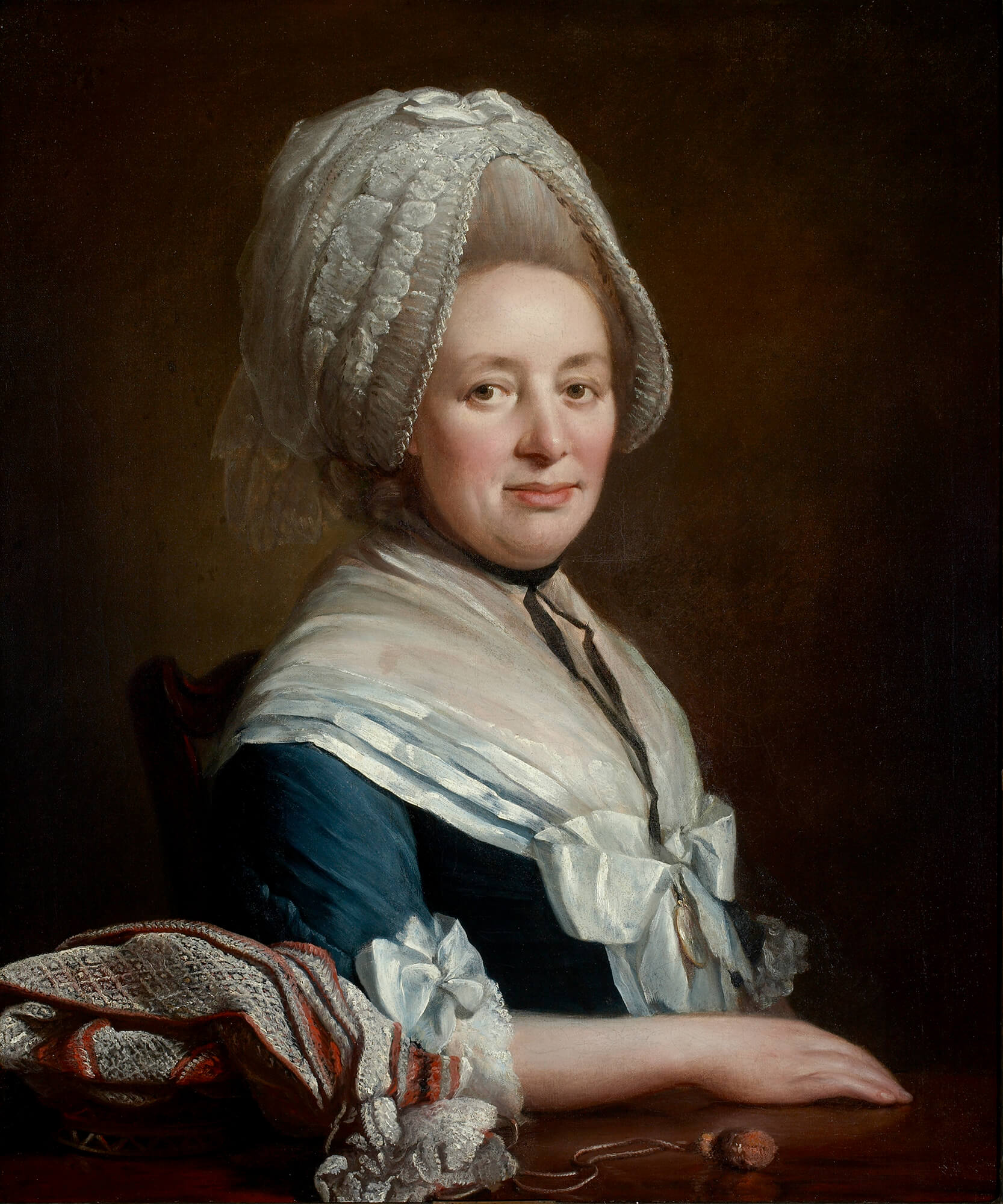
Elisabeth Ourry seated at a table in a blue dress
1780
Oil on canvas
30 x 25 ins., 76.5 x 63.5 cms
About the Sitter
Elisabeth Ourry (1745 – 1811) was born 22 February 1745, the daughter of Louis Ourry of Blois (1682 – 1771) and his wife Ann Louise Beauvis. On 17 December 1764 she married, at St. Matthew’s Bethnal Green, Samuel Beuzeville (1717 -1782). He was born at St. Thomas de Gruchet, near Bolbec, Normandy and educated at Merchant Taylors School and St. John’s College Oxford. He was an uncle of Pierre Beuzeville, a Spitalfields silkweaver who moved to Henley-on-Thames in 1797.
Samuel Beuzeville took Holy Orders. He was minister at La Patente from 1753 to 1761 and was pastor of the French Church of St. Jean, Spitalfields from 1758 to his death in 1782. He also held the post of minister at the English parish church of Fumes. He was buried in the churchyard of St. Dunstan’s Stepney.
Samuel and Elisabeth had one child, Elizabeth Charity Beuzeville. She was born 5 December 1765 and baptised by her father at St. Jean’s. She was admitted to the church on 20 April 1783, being described as the heiress of the Reverend Samuel Beuzeville and her uncle Rear Admiral George Ourry who died without issue in the same year as his wife, the Hon. Amelia Newton.
In 1783 Elizabeth Charity married Col. Thomas Lampiere (1756 – 1823) at St. Helier. He was Commissary General for Jersey and Guernsey. Elizabeth died in Jersey in 1806.
About the Artist
Mason Chamberlin studied with Francis Hayman as a portraitist. He was a founder member of the Royal Academy where he exhibited from 1769 to 1786. He also exhibited portraits and history paintings at the Society of Artists between 1760 and 1765 and at the Free Society in 1764. Of his identified portraits, many were of scientific or medical men. He also won a commission from the royal family to paint a portrait of Prince Edward and Princess Augusta which was exhibited at the Royal Academy in 1771.
His work is included in the collections of the National Maritime Museum, the National Portrait Gallery, the Royal Society (London), the Yale Center for British Art and the Philadelphia Museum.
Condition
Very good
Provenance
- Geoffrey Bristed
- Christie’s, 21 March 1969, lot 60 (illustrated)
- Viscountess Boyd of Merton, Ince Castle
- Christie’s, 9 February 1990, lot 113
Literature
- Ellis Waterhouse The Dictionary of 18th Century British Painters, p. 78, illustrated.