
Click any image to view full size with zoom
"A.B."
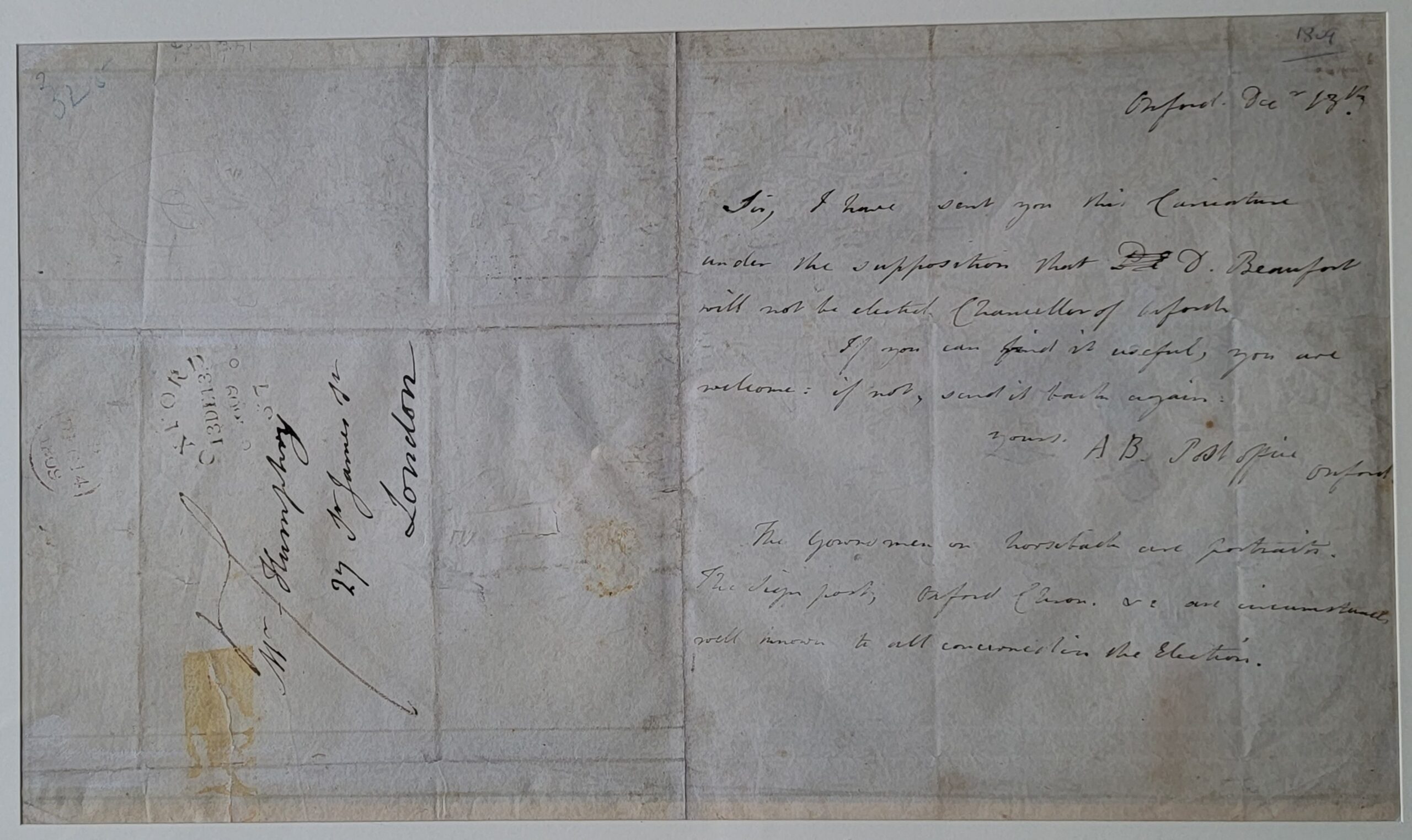
A letter written on December 13th 1809 (the day of the poll) by “A.B.” to the print seller Mr. Humphry in St. James’s, with the caricature on the reverse.
Signed with monogram and dated 1809
Pen & ink & watercolour on paper
7.5 x 14 ins, 19 x 35.56 cms
About this Work
Concerning the election for the Chancellor of the University of Oxford in November 1809
Framed with a glazed back to show the letter
“A Blank Day with the Duke” features William Grenville on horseback to the left, trailing a papal tiara and pursued by the hounds; Lord Eldon in his Lord Chancellor’s robes as a Pillar of State in the distance among the domes and spires of Oxford; the Duke of Beaufort in blue hunt coat in the right foreground, surrounded by the heads of Balliol, Worcester and Oriel (Dr. Parsons the Vice-Chancellor, Drs. Landon and Eveleigh) and, to his right holding The Oxford Chronicle, Dr. Hodson of Brasenose. In the centre, whipping in the voters, is probably Charles Henry Hall who had become Dean of Christ Church in October 1809. The academic dress hanging on the signpost refers to Thomas Burgess, former fellow of Christ Church and, in 1809, the Bishop of St. David’s. Burgess was a life-long opponent of Catholic Emancipation.
Following the Act of Union with Ireland in 1801, legislation to allow Roman Catholics an unrestricted right to sit in Parliament was strongly opposed by the Tories, and by George III, and was seen as a threat to the established church.
The office of Chancellor became vacant on the death of the Duke of Portland on 30th October 1809. Lord Grenville became a candidate; he was also the leading supporter of the Roman Catholics. Lord Eldon, the Lord Chancellor, had at first resisted pressure to stand but was persuaded to put his name forward in the belief that the Duke of Beaufort had resolved not to take part. His proposers were Drs. Parsons, Landon and Eveleigh. Then, however, the Duke of Beaufort changed his mind and entered as a third candidate, splitting the Tory vote.
The Prime Minister, Spencer Perceval, wrote to the King expressing his embarrassment at the advantage this split in the vote would give to Lord Grenville. Perceval hoped that, previous to the election, “a communication may take place between the Lord Chancellor’s and the Duke of Beaufort’s friends, and upon examination of their respective strengths the person of the two who appears to have the least chance might endeavour to transfer as far as he can the votes of his friends to the other as the best means of preventing Lord Grenville from having the triumph of succeeding just at this moment, after the publication of his obnoxious opinions in a place where those opinions should meet with every discountenance.”
Those last words referred to Grenville having restated his views on Catholic Emancipation in a letter to Dr. Hodson, Principal of Brasenose. Dated 2nd November it was intended for private circulation amongst the Oxford voters whilst he was campaigning for the Chancellorship of the University.
The Whigs conducted the campaign for Grenville not just with vigour but with the use of inappropriate inducements and deception. Grenville’s own college of Christ Church made a powerful muster. At Brasenose, the body next in influence after Christ Church, the Principal Dr. Hodson (a friend of Grenville’s family) was ceaselessly active in writing to canvass absent voters, notwithstanding that his partiality might have made this a breach of the College Statutes. In the context of the hierarchies of the university and of the church, some of this canvassing exerted undue influence. There was also the matter of the misreporting of Grenville’s letter to Dr. Hodson. In that letter Grenville had repeated his known attitude towards the papists and had not stated any intended change in his views or conduct. Immediately, gross misrepresentations of its contents were disseminated widely. It was reported that Grenville had seen reason to change his opinions of papists and was determined to withdraw his future support for them. Hodson refused to correct the facts by publishing the real letter, using the excuse that it was a private letter. Accordingly, votes were canvassed in reliance on the reassurances in the false reports. Eldon wrote: “There is a canvass on the other side carried on in a way that I cannot reconcile to my old ideas of Oxford delicacy.”
There was also a political dimension in that Spencer Percival’s ministry seemed insecure and likely to be succeeded by an administration led by Grenville in which Eldon would not be Lord Chancellor. This may have influenced the views of some uncommitted voters.
Eldon based his campaign on the imagined threat to the interests of Church and State. He mentioned that Grenville’s election would be the immediate precursor to Catholic emancipation. But no accommodation was reached with Beaufort’s supporters and Grenville won the election with 406 votes to 393 for Eldon and 288 for Beaufort. Eldon, not being from an ancient noble family, thought his defeat was the result of “aristocratic combination”. On the evening before the close of the poll a critical number of Beaufort’s friends had switched their votes to Grenville and Beaufort’s committee had not allowed any of them to vote for Eldon. Eldon described himself as not having chosen “to sacrifice the pretensions of a man long labouring for the public to a fox-hunting Duke”. Of the bishops entitled to vote only two had voted for Eldon, all the rest for Grenville.
In the caricature, the election is under way. Grenville is seen galloping to the left towards the “Mystery” of Rome, trailing a papal tiara which is pursued by the hounds/electors. The signpost points his direction as “To R[ome]” and has the image of a cardinal’s hat. The opposite finger points “To St. David’s” with the image of a bishop’s mitre, in the direction of Eldon the Pillar of State. This refers to the established Anglican Church and the opponents of Catholic Emancipation, as represented by Thomas Burgess the Bishop of St. David’s and an entitled voter.
The action is taking place on the right, around the mounted figure of the Duke of Beaufort. Grouped beside him are Drs. Parsons, Landon and Eveleigh. Although they had previously proposed Eldon’s candidature, they are now suggesting to the Duke that he gets his friends and supporters to switch their votes to Grenville. Behind them stands Dr. Hodson holding a copy of the Oxford Chronicle which features a news item headed “A Caution” and “BEWARE”. This represents the misreported account of the contents of Grenville’s letter which Dr. Hodson had refused to correct. On the back page of the paper is an item headed “Old Prices”. This was a contemporaneous news item, the riots at Covent Garden in protest at the increase in admission prices. The riots had in fact been incited by exaggerations in advertisements and letters carried in various newspapers.
In the centre Dr. Hall urges the straggling voters to follow the pack.
Provenance
Private collection UK since the 1960s.