On stand
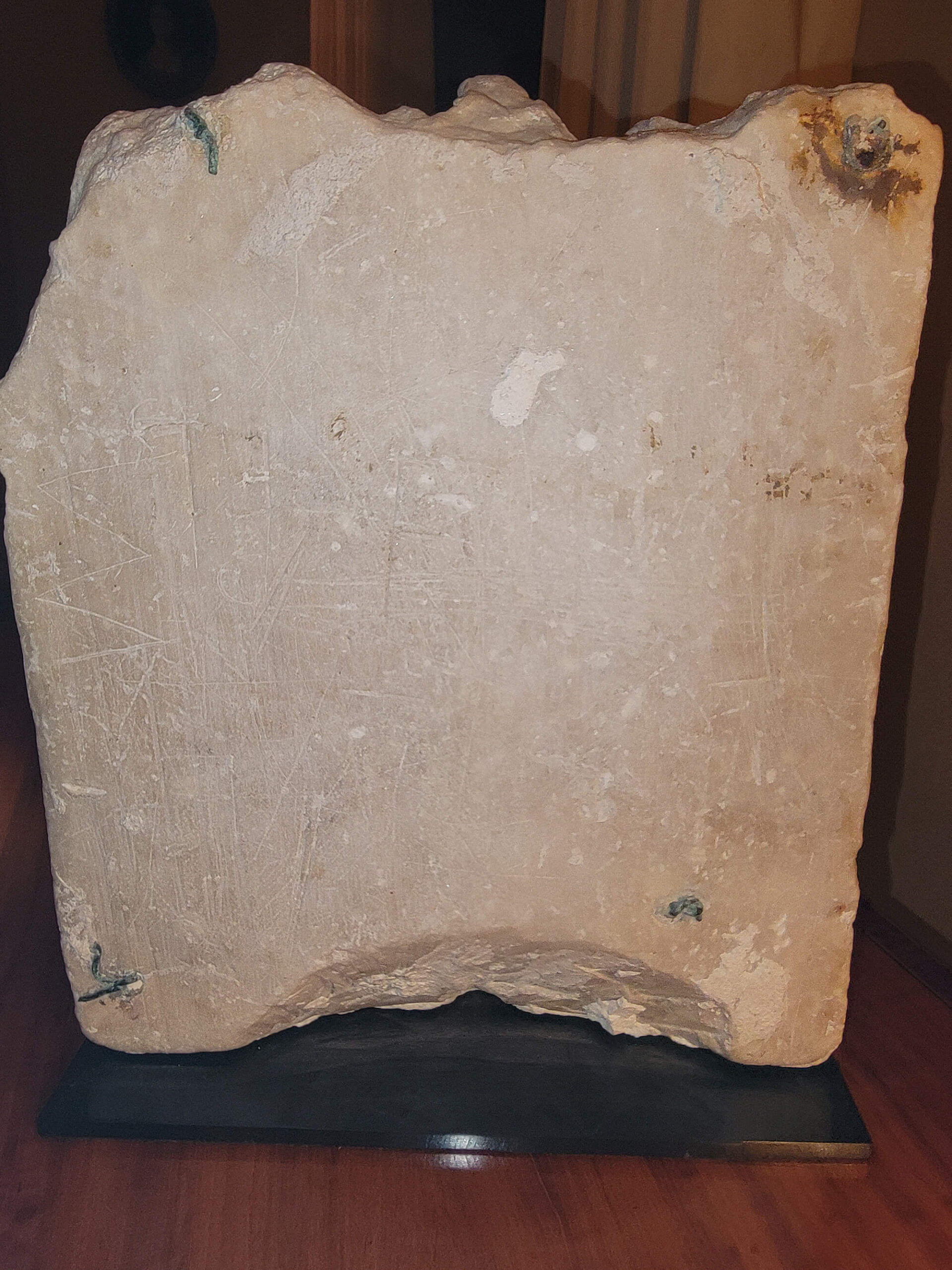
Reverse with incised marks
Click any image to view full size with zoom
English carved alabaster relief
15th century
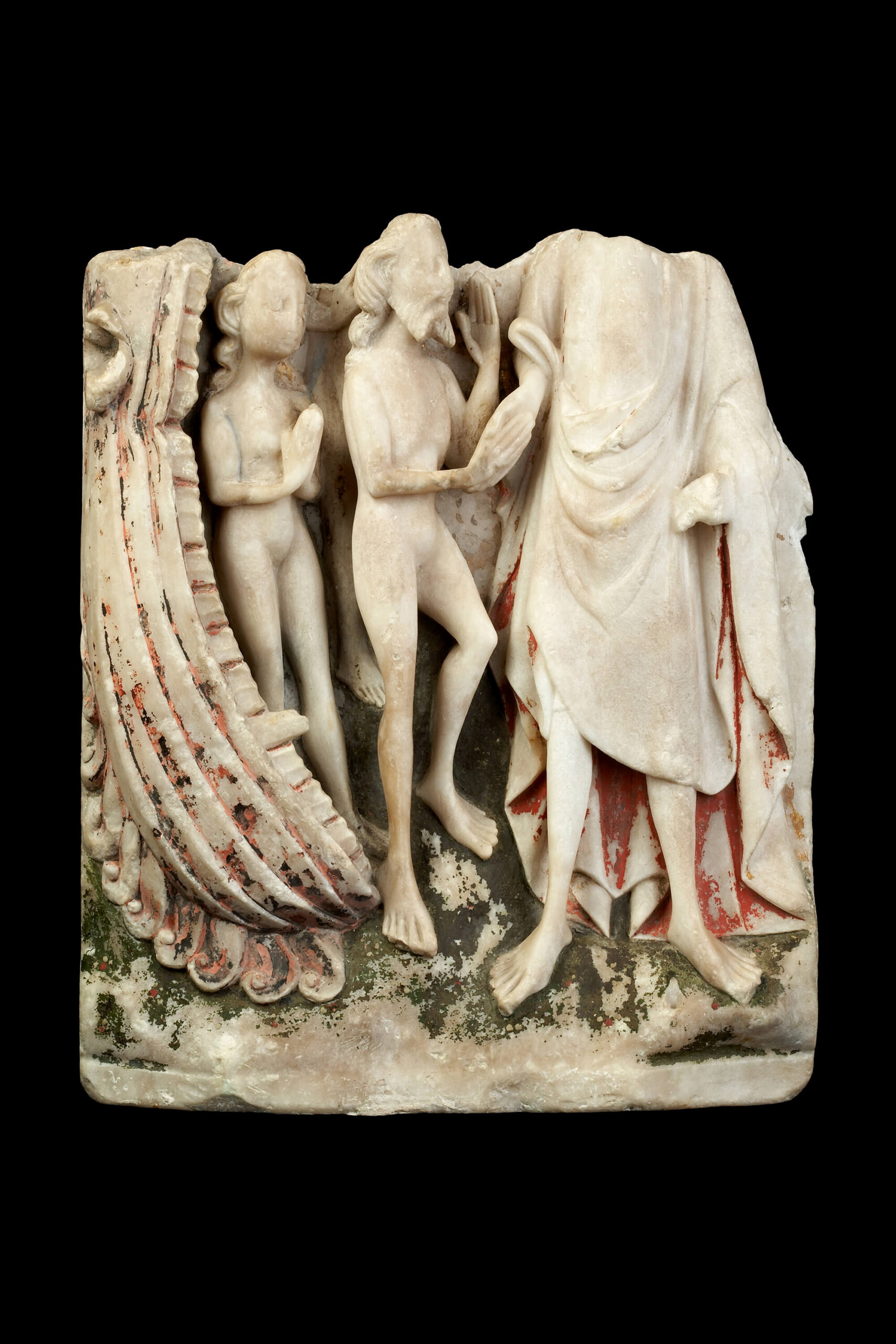
Christ’s descent into Limbo
Circa 1450
Alabaster with polychrome decoration
12.6 x 10.5 ins, 32 x 26 cms. Mounted on modern metal stand
There are incised marks on the reverse of panel
About this Work
Although the top part of this panel has been lost, the carving retains its impact as a work of art. It is also of much art historical interest in relation to the sources used by the alabastermen, the iconography of the panels and their methods of production.
The Golden Legend is clearly the main direct or indirect source for the subject, as to which see further below. The panel represents the apocryphal story from the gospel of Nicodemus, which is retold in The Golden Legend, of how Christ descended into Limbo to lead out from Hell Adam and the patriarchs and prophets of the Old Testament who had died before he redeemed mankind.
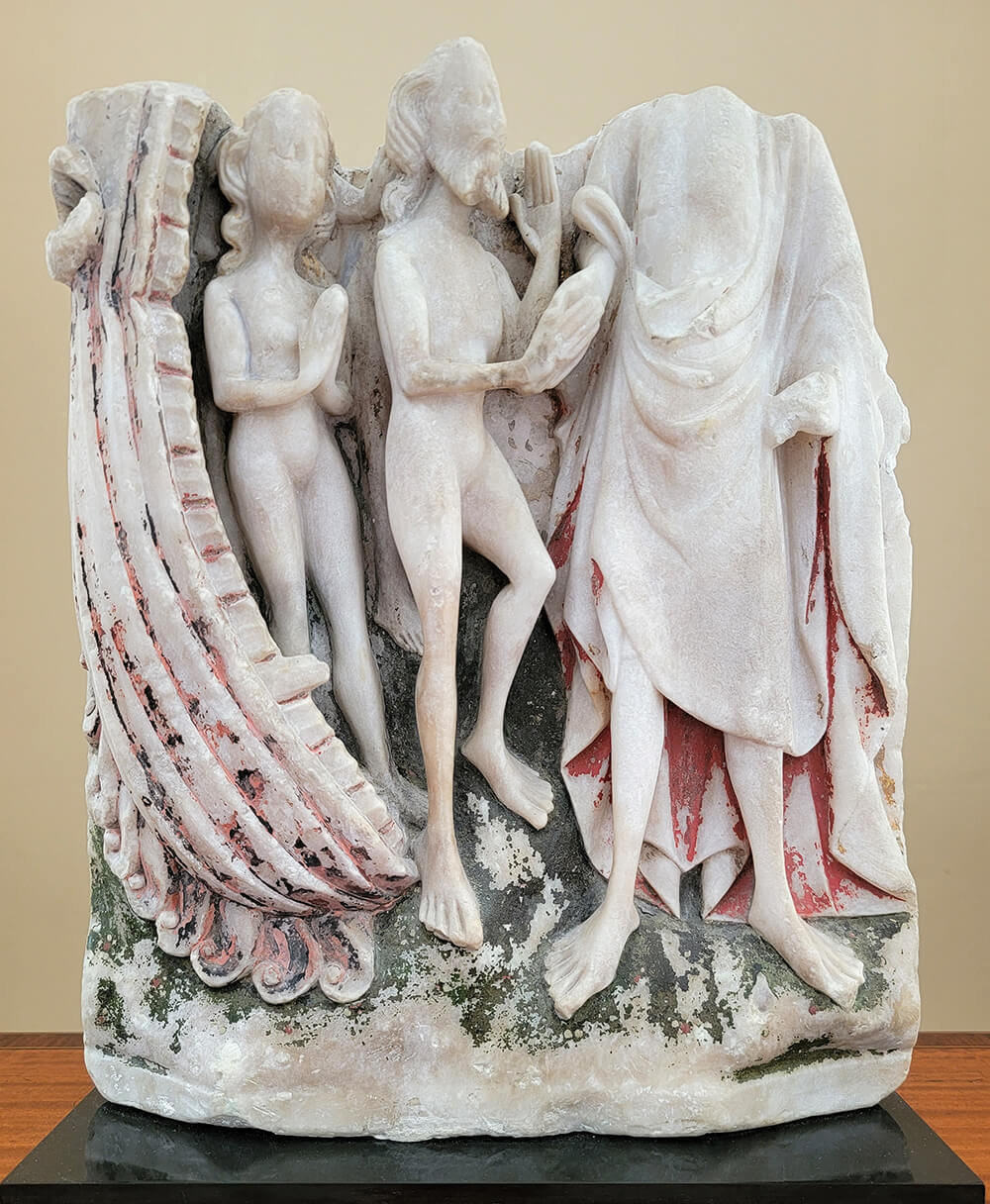
A large figure of Christ stands on the right of the panel. He wears a three-quarter length robe which hangs from his shoulders, leaving his chest bare, and a full-length cloak with broad sleeves. His feet are bare. His head is missing. In his left hand he would have held the cross-staff of the Resurrection but this is lost. His right hand grasps the right hand of Adam as he ushers him from the jaws of Hell. Adam, with a scrolled beard, is naked. He raises his left hand in acknowledgement of Christ. He is followed by Eve, again naked, with her hands clasped in prayer. In the background is the right leg of another figure emerging from Hell whose face would have been in the lost section of the panel. Behind Eve, the left side of the panel is taken up by the enormous jaws of Leviathan representing the jaws of Hell. Again, the uppermost part is lost. It may have been surmounted by a representation of a devil as the gatekeeper of Hell.
The upper quarter of this dramatic image is missing. The condition of the surviving part is generally reasonable. There is some surface wear but the only other loss is Christ’s cross-staff. There is some chipping on the lower edge of the base. There are surviving traces of polychrome decoration. There is red on the lining of Christ’s cloak and on the jaws of Leviathan, green with flowers on the foreground and green on the middle distance background.
The composition is spacious and the carving is sophisticated and elegant.
There are fixings with latten wires still attached on the back of the panel, two either side at the base and two either side very near what is now the top but which would have been about two-thirds the way up. The panel is quite thick and the back has been hollowed out in the conventional manner at the base.
Since the 12th century, Christ in Limbo had been a popular subject with painters and sculptors. This popularity must have been enhanced later by the influence of The Golden Legend. This work, compiled in the mid-13th century, was extensively known and manuscript copies circulated widely. Caxton’s version in English was printed in 1483. The Golden Legend was a strong literary influence on the alabastermen but it is difficult to separate this influence completely from that of contemporary religious belief and practice. It is therefore probably safer to say that it was an influence rather than a source for the carvers. The Golden Legend was popular because it wrote up the life of the Virgin, the life of Christ and the lives of the Saints with colourful detail and included not a little artistic license. It was in effect artistically enhanced religion and thus not always respectful of the orthodoxy of the Church but it was popular and influential. It had an effect on what people believed and on aspects of liturgical practice. From time to time, therefore, its factual accounts were criticised by the Church. But a good story can also translate into dramatic theatre or a dramatic carving.
Dealing with the Resurrection, The Golden Legend recounts two sources on how Christ descended to Limbo. The first was a sermon of Augustine and the second the Gospel of Nicodemus. Augustine is quoted “As soon as Christ yielded up his spirit, his soul, united to his deity, went down to the depths of hell.” The infernal legions were terrified and the dead became confident and joyous. Then “at the Lord’s command all the iron bars were shattered and innumerable peoples of the saints, throwing themselves at his feet, called out with tearful voice ‘You have come, Redeemer of the world, you have come, you whom we longed for and waited for day by day! You have come down to hell for us! Leave us not when you ascend again to the upper world! Go up, Lord Jesus, leave hell stripped of its prey and the author of death bound again in his chains!’”
The Gospel of Nicodemus (itself a late and embroidered text) is quoted where it recounts how the prophets and patriarchs greet Christ’s coming. “While we were in thick darkness with all our fathers the patriarchs, a gold and royal purple sunlight suddenly burst upon us. At once Adam, father of the human race, rejoiced, saying ‘This is the Light of the Author of the everlasting light, who promised to send us his coeternal Light.’ And Isaiah exclaimed ‘This is the Light of the Father, the Son of God, as I, when I was alive on earth, predicted, saying, The people that walked in darkness have seen a great light’”
This panel is also a good example of the influence of the medieval stage on the compositions found on the alabaster panels. A dramatic and awe-inspiring subject, it is also highly stylised and the jaws of Leviathan, commonly used in medieval depictions of the hell-mouth, have all the appearance of a stage set.
This is an uncommon subject. Cheetham 2003[1] lists 8 recorded versions only one of which was outside a museum collection. The present panel is not listed.
There is a fragment in the British Museum of the Damned led into Hell where a devil leads figures into the jaws of Leviathan on the right of the panel.
There are close resemblances between the present panel and one in the Musée des Antiquités, Rouen: see Rouen-Evreux[2] page 117, number 44 or Cheetham 2003, page 20, figure 15. The Rouen panel measures 42.5 x 27.5 cms.
From these compositions it can also be concluded that patterns were used to mark the alabaster tables for carving and that these patterns were sometimes reversible. Examples of other subjects where obverse and reverse versions are known include the Adoration of Mary and Joseph, the Adoration of the Magi, Christ washing the feet of the Apostles, the Betrayal, Christ before Caiaphas, the Entombment, the Harrowing of Hell and the Resurrection.
Notes
- 1. Cheetham 2003: Francis Cheetham, Alabaster Images of Medieval England
- 2. Rouen-Evreux: Catalogue of the 1998 exhibition D’Angleterre en Normandie. Sculptures d’albâtre du Moyen Age.